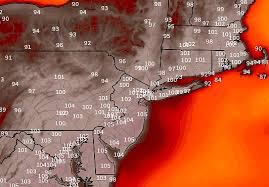
South Jersey is heading into the most dangerous stretch of weather so far this year. This is not ordinary summer heat, and forecasters are urging everyone to take it seriously. The overnight lows won't cool off. The power grid is under strain. And the people most at risk are often alone, without reliable air conditioning, and without someone checking on them.
What to Expect
Here's how the week is shaping up, according to National Weather Service forecasts:
| Day | Conditions | Key Risk |
|---|---|---|
| Wednesday, July 1 Warning Begins Noon |
Sunny and hot — highs near 90° | Heat building — first day of the warning |
| Thursday, July 2 Dangerous |
Highs in the upper 90s, pushing toward 100° | Dangerous heat sets in — limit outdoor time |
| Friday, July 3 Extreme |
Highs around 100° — heat index could top 110° | Potentially the hottest day — stay in AC midday |
| Saturday, July 4th Still Dangerous |
Highs in the 90s, humid — brief storms possible | Grid strained all day; if outdoors, plan carefully |
For perspective: New Jersey's all-time record high is 110 degrees, set back in 1936. Forecasters aren't predicting we'll break that record outright — but the fact that the "feels-like" numbers are getting close is exactly why this heat wave demands respect.
Here's the part that makes a multi-day heat wave so dangerous: the nights won't cool off. Overnight lows are expected to stay in the mid-70s to low 80s, which means homes without air conditioning never get a chance to recover. The heat just builds, day after day.
A few scattered thunderstorms are possible Friday and Saturday afternoons, which could bring brief relief — but they could also bring heavy rain and gusty wind, and not everyone will see them.
Who's Most at Risk
Heat is the deadliest weather hazard there is — more than storms, more than cold. The people in the most danger this week are:
- Older adults, especially anyone living alone
- Young children and infants
- Outdoor workers — landscapers, contractors, roofers, anyone on a job site
- People without reliable air conditioning
- Anyone with heart or breathing conditions
Your body reacts to what the air feels like, not what the thermometer technically reads. A 110-degree heat index is dangerous whether or not the thermometer hits triple digits.

When temps push 100°, South Jersey residents find any way to cool down. Know the signs of heat illness — heavy sweating, dizziness, nausea, confusion — and check on your neighbors daily.
How to Stay Safe
The guidance from the National Weather Service and the NJ Department of Health is straightforward:
- Drink plenty of water — more than you think you need, and don't wait until you're thirsty.
- Stay in air conditioning during the hottest part of the day. If you don't have it at home, spend the afternoon somewhere that does — a mall, a library, a community cooling center.
- Limit time outdoors and strenuous activity, especially midday. If you work outside, take frequent breaks in the shade or AC.
- Never leave children or pets in a parked car — not even for a minute. A car interior can reach lethal temperatures within minutes.
- Know the warning signs of heat exhaustion and heat stroke: heavy sweating, dizziness, nausea, headache, confusion, or a body that suddenly stops sweating. If someone shows signs of heat stroke — confusion, hot dry skin, fainting — call 911 immediately.
The Power Grid Is Under Strain, Too
This heat wave isn't just hard on people — it's hard on the electric grid. When millions of air conditioners run flat-out for days, demand spikes to levels the system rarely sees.
The regional grid operator that serves New Jersey, PJM Interconnection (which covers 67 million people across 13 states), is forecasting electricity demand this week that could break its all-time record, set back in 2006. Ahead of the heat, the U.S. Department of Energy issued an emergency order allowing power plants to run at maximum output to keep up. Grid operators say they expect to have enough power — but with the system stretched this thin, the risk of localized outages goes up.
A few simple moves make a real difference — and most of them will also lower your electric bill:
- Set your thermostat to 78°F when you're home. Every degree below 78 can add roughly 3–5% to your cooling costs.
- Pre-cool your home in the morning, then let it coast in the afternoon. Peak grid hours are approximately 2 p.m. to 7 p.m.
- Run big appliances at night — dishwasher, dryer, washer — after 7 p.m.
- Close blinds and curtains on the sunny side of the house to block heat before it gets in.
- Grill outside instead of running the oven, which dumps heat into the house and makes your AC work harder.
- Use fans to feel cooler so you can keep the thermostat a little higher.
One important note: if anyone in your home relies on electricity for life-sustaining medical equipment, contact your utility now so you're on their priority list. PSE&G customers can register at pseg.com/life or 1-800-436-7734; other utilities have similar programs.
Protecting Your AC and Your Home: A Pro's Checklist
In heat like this, your air conditioning isn't a luxury — it's a safety system. A stretch of days where it runs nonstop is exactly when tired or neglected equipment fails. A few smart steps now can keep your system running when you need it most.
Before the worst of it hits:
- Change or clean your air filter. A clogged filter is the number-one cause of an AC struggling or freezing up. This is the single easiest thing you can do, and it helps immediately.
- Clear around your outdoor unit. The condenser (the box outside) needs airflow. Pull weeds, cut back grass, clear leaves — at least a couple of feet of open space around it.
- Make sure vents and returns aren't blocked by furniture, rugs, or boxes. Your system can only move the air it can reach.
- Set the thermostat to a steady temperature rather than cranking it way down and back up. Big swings make the system work harder without cooling faster.
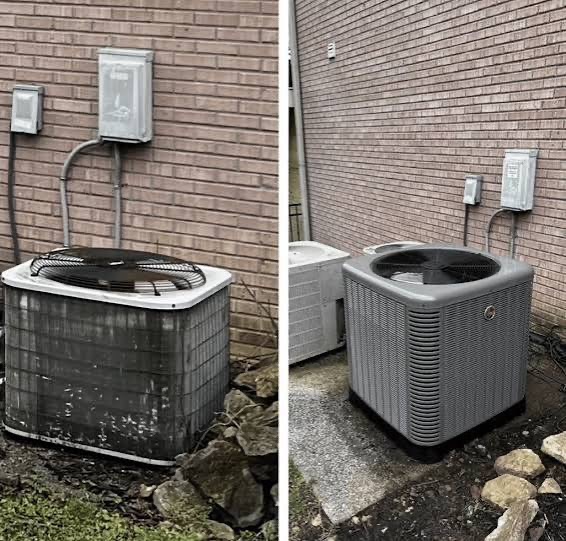
Left: a condenser that hasn't been serviced — clogged, straining, and running inefficiently. Right: the same type of unit after a proper cleaning. The difference in efficiency, airflow, and lifespan is significant.
Protecting your electrical system:
- Don't overload your circuits. When the AC is pulling hard, piling on additional loads on the same circuit can trip breakers — or strain older wiring. Spread heavy loads across different circuits.
- Guard against power surges. Brownouts and voltage dips can damage sensitive electronics and even AC compressors. A whole-home surge protector is the real fix; short of that, unplug expensive electronics if the power starts flickering.
- If your breaker keeps tripping or you smell anything hot or electrical, stop and call a licensed electrician. In extreme heat, an overloaded electrical system isn't just an inconvenience — it's a fire risk.
If you run a generator during an outage:
- Never run a generator indoors, in a garage, or near windows. Generator exhaust contains carbon monoxide, which is odorless and kills. Keep it well away from the house.
- Make sure your home has working carbon monoxide detectors.
It's Not Just Homes — Restaurants, Offices, and South Jersey Businesses Face the Same Risk
When we talk about AC failures in a heat wave, the picture that comes to mind is a homeowner sweating through the night. But the maintenance problem is just as bad — often worse — in South Jersey's commercial spaces. Restaurants. Office buildings. Retail stores. Medical offices. Most of them are running their systems harder than any home ever will, on the same maintenance schedule: none.
A restaurant kitchen during a heat wave is already pushing ambient temperatures above 100°. The HVAC system has to fight cooking heat plus outdoor heat — through ductwork and coils that, in most cases, haven't been professionally serviced in years. When that system fails, it's not just discomfort. It's a health code issue. A food safety issue. A forced closure.
Office buildings and commercial spaces face a quieter version of the same problem. Employees breathing air circulating through clogged, dirty systems aren't just uncomfortable — they're less productive and more likely to take sick days. The research on this is consistent and well documented:
- Studies from the Harvard T.H. Chan School of Public Health show that improved indoor air quality can reduce employee sick leave by up to 27%
- The Harvard Business Review has found that cleaner air can improve cognitive function and workplace productivity by 8–11%
- The U.S. EPA's "Business Case for IAQ" documents that businesses investing in their indoor air systems save thousands annually in lost time and healthcare costs
That's not small numbers. A business with 10 employees averaging two sick days a year per person — shave 27% off that, and you're keeping people at their desks. Better filters and clean coils don't just protect equipment. They protect the people working inside.
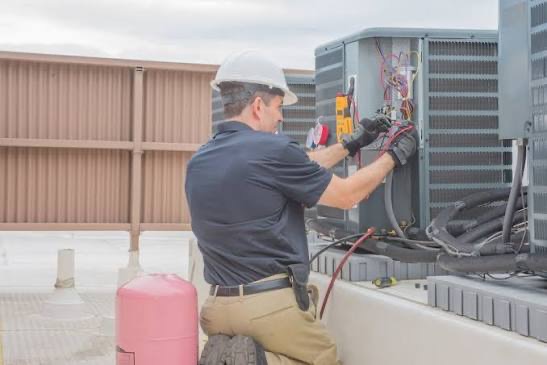
Commercial rooftop HVAC systems handle far more demand than residential units — and are often the last to receive maintenance attention. In a heat wave, a neglected commercial system isn't a small problem. It's a business closure risk.
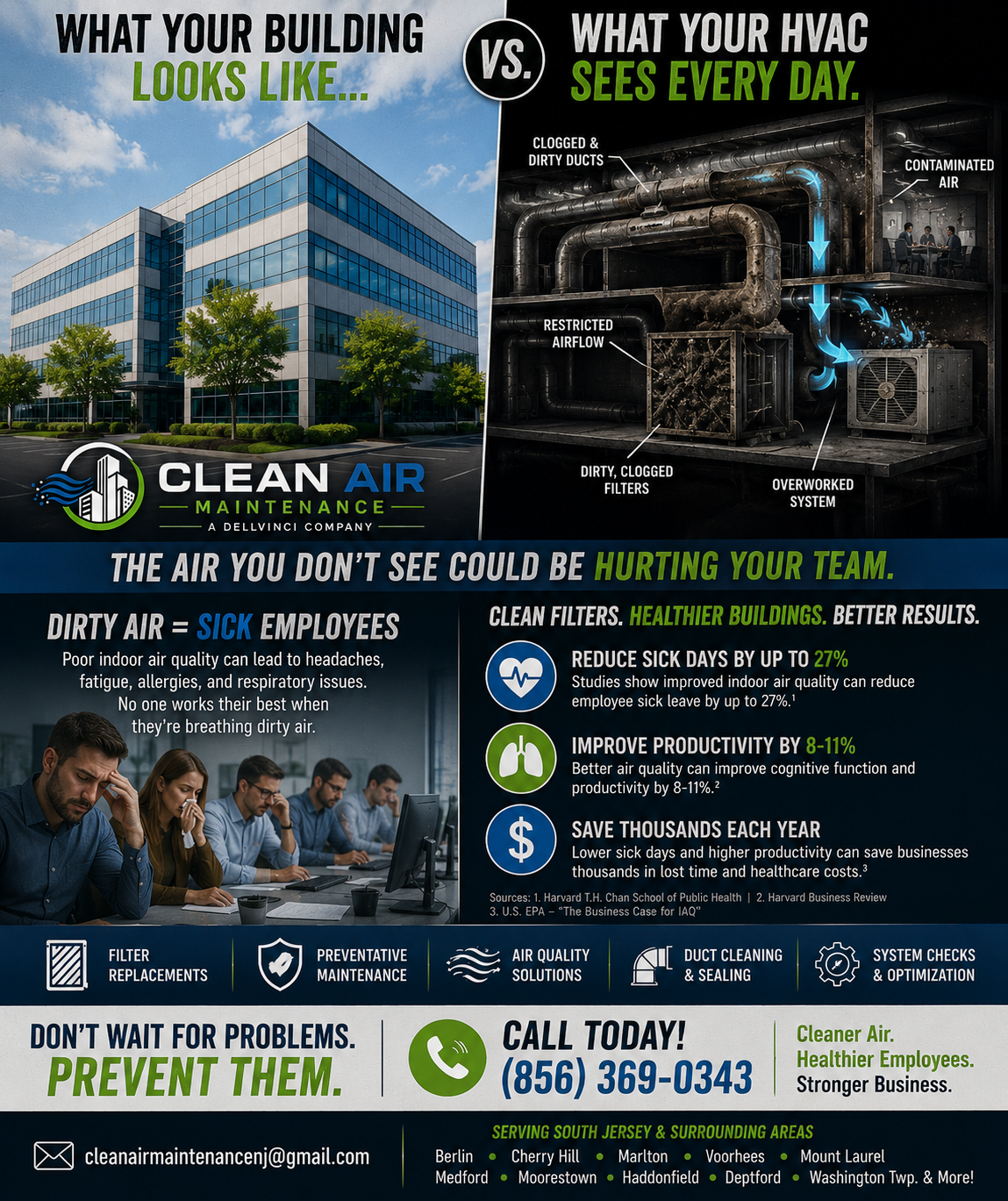
The business case for indoor air quality — sourced from Harvard and the EPA. Clean filters aren't just about comfort. Call Clean Air Maintenance: (856) 369-0343 →
Local Professionals Available This Week
A heat wave is the worst time to find out your HVAC system or electrical panel can't handle the load. These two South Jersey companies handle exactly this kind of work — homes and commercial buildings — and both are available right now.
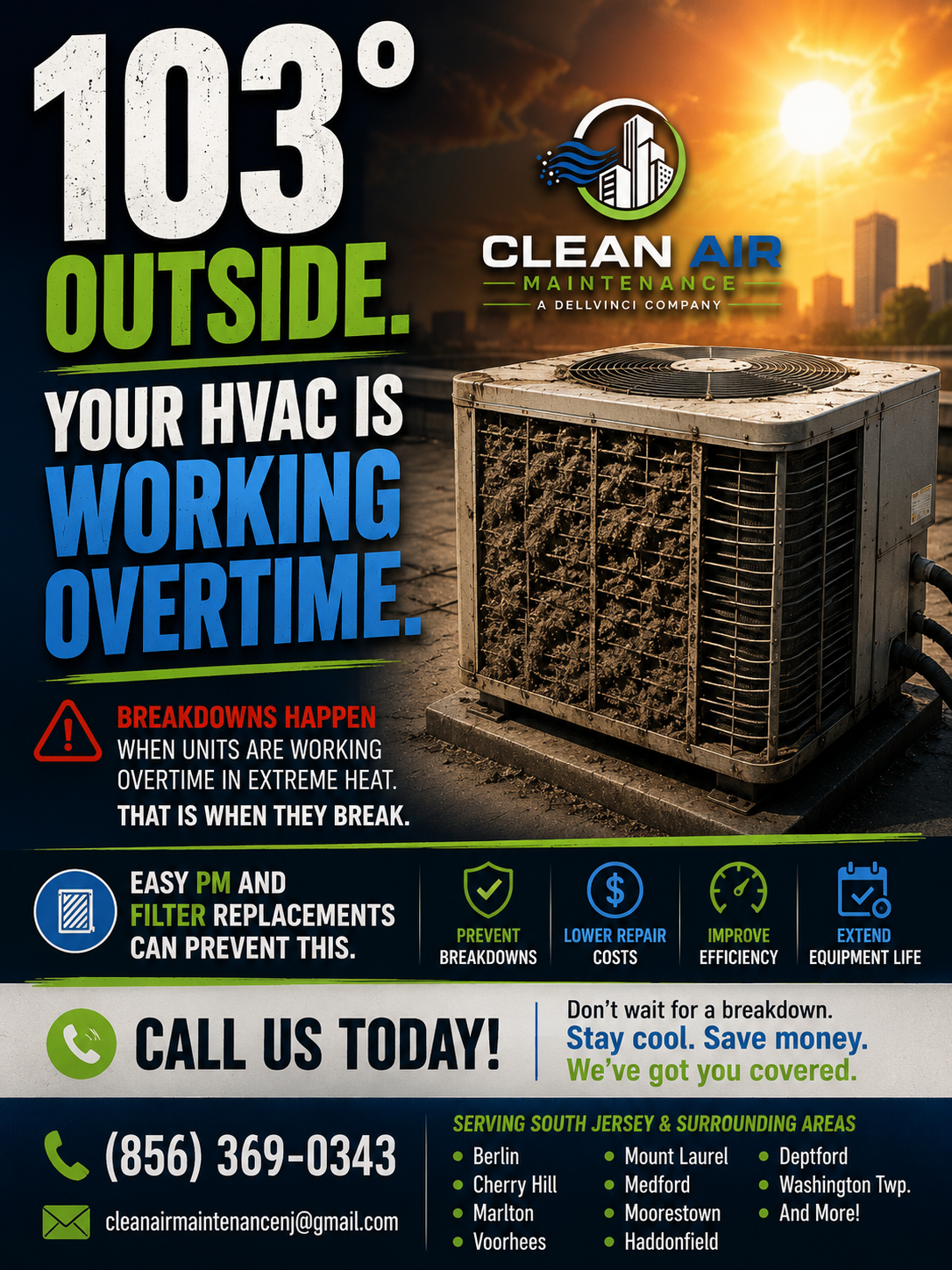
Clean Air Maintenance · South Jersey · (856) 369-0343 · Call Now →
Don't Wait Until Your AC Fails in 100° Heat
A clogged filter, a dirty coil, or a neglected system doesn't fail on a nice day — it fails when it's running hardest. Clean Air Maintenance handles scheduled filter replacement, preventative HVAC maintenance, and full system check-ups for South Jersey homes and commercial buildings. One call. They come to you. Filter, coil inspection, airflow check — all of it, done right.
📞 Call (856) 369-0343Clean Air Maintenance · South Jersey · Residential & Commercial · cleanairmaintenancenj@gmail.com
Breakers Tripping? Outlets Warm? Call a Licensed Electrician — Now
When the AC runs nonstop for days, it pushes electrical systems harder than any other time of year. Breakers that keep tripping, outlets that run warm, lights that flicker — none of that is normal, and in a heat wave, it's urgent. Chris Borsello and CMEC have handled South Jersey electrical work for over 20 years. Licensed in NJ and PA. The phone that never stops ringing.
Read Their Story →CMEC · Christopher Michael Electrical Contracting · South Jersey · Licensed NJ & PA · HVAC + Refrigeration + Mechanical
💡 The $15 Trick That Actually Works If Your AC Goes Down
- Fill a cooler with ice, then add a generous amount of regular table salt. Salt drops the temperature of ice significantly below 32° — this is real chemistry, not a hack. You get a much colder slurry than ice alone.
- Add enough water to create a cold slurry. This conducts cold more efficiently than dry ice.
- Put sealed water bottles in for 10–15 minutes, then hold them against your wrists, neck, and ankles — your pulse points. This brings your core temperature down faster than almost anything else.
- Or: place a bowl of the salted ice in front of a box fan. The air blowing over it drops room temperature several degrees — a makeshift evaporative cooler.
- Total cost: $3–5 for ice, salt you almost certainly have, and a cooler if you own one. Under $15 to set up a real emergency cooling station.
It won't replace AC — but it can make a dangerous situation survivable while you wait for help or get to a cooling center.
If your AC fails in the middle of this: don't wait it out in a dangerously hot house. Get to a cool place — a friend or relative's, a mall, a library, a cooling center (dial 2-1-1) — and get the system looked at. A house without AC during a 100-degree stretch becomes dangerous fast, especially for the very young, the elderly, and anyone with health conditions.
The Most Important Thing You Can Do
Here's the truth about heat waves: the people who die in them are very often elderly, living alone, without working air conditioning — and no one checked on them in time.
That's where a community like ours matters more than any forecast. The single most valuable thing you can do this week is check on the people around you. An elderly neighbor. A relative who lives alone. Anyone you know who might not have good air conditioning.
And "checking on them" means more than a text. It means calling and actually talking to them, or better yet, physically stopping by — Wednesday, and again each day through Saturday. A knock on the door might be the thing that makes the difference.
This is what a neighborhood is for.
A Word on the Fourth of July
Independence Day falls right in the teeth of this heat wave, and plenty of towns across South Jersey have celebrations planned. If you're heading out to a parade, a fireworks display, or a community event this weekend:
- Bring water and drink it steadily
- Wear light, loose, light-colored clothing
- Find shade, take breaks, and pace yourself — especially with kids and older family members
- Keep an eye on everyone in your group, and don't be shy about heading somewhere cool if anyone starts feeling off
You can still enjoy the holiday. Just plan for the heat instead of pretending it isn't there.
Where to Get Help
- For cooling centers and local assistance, dial 2-1-1 — New Jersey's free, 24/7 helpline (or visit nj211.org)
- For the latest forecast and alerts, check the National Weather Service at weather.gov
- For PSE&G medical equipment registration, call 1-800-436-7734 or visit pseg.com/life
- In a medical emergency, call 911
Stay cool, stay hydrated, and look out for each other, South Jersey. We'll get through this stretch the way we get through everything — together.