
It is July 4th again. The fireworks are going up. The flags are out. Somebody near you is doing something to a grill that should probably be investigated. And across every television in America, someone is reading the Declaration of Independence with great solemnity, attributing its birth to a single sun-drenched afternoon in Philadelphia in 1776. Most of what they're about to say is true. Some of it is incomplete. And a few things everyone assumes — things you've probably repeated at some point — are quietly, fascinatingly wrong.
This is not an attempt to tear anything down. Two hundred and fifty years is worth celebrating. But the real story is more interesting than the myth. The founders were more flawed, more brilliant, more human, and more afraid than the statues suggest. And the ideals they put on paper cost them more than most people know.
So before the fireworks. Here is what actually happened.
Chapter OneIt Didn't Happen on the Fourth
The date Americans celebrate is not the date America declared independence.
On July 2, 1776, the Continental Congress voted — 12 colonies in favor, New York abstaining — to approve the Lee Resolution, formally severing ties with the British Crown. That was the vote. That was the decision. That was the moment the colonies stopped being colonies.
John Adams, who was there in the room, wrote to his wife Abigail the very next day with the conviction of a man who had just witnessed something the world would never forget. He predicted the anniversary would be celebrated "with Pomp and Parade, with Shews, Games, Sports, Guns, Bells, Bonfires, and Illuminations from one End of this Continent to the other." He was describing July 2nd. He was off by two days.
July 4th is the date Congress formally adopted the written text of the Declaration — the document itself, edited down from Jefferson's original draft and certified for publication. It is the birthday of the document, not the decision. The decision came two days earlier. Adams, a man of considerable ego, spent years quietly annoyed that the country had gotten the date wrong.
Chapter TwoAlmost No One Signed It That Day
When you picture the Founding Fathers gathered around a table on July 4th, quill pens in hand, signing their names to history — that scene did not happen.
On July 4, 1776, exactly two people signed the Declaration: John Hancock, as President of Congress, and Charles Thomson, the Secretary, who certified it. That's it. The rest of the 56 signatures most Americans associate with that document were added more than a month later.
The engrossed parchment — the formal hand-lettered version most people have seen — wasn't even ready yet. It had to be prepared by a calligrapher. The majority of delegates signed on August 2, 1776. Several signed even later. Two men who voted for independence never signed at all: Robert Livingston of New York, who was recalled home before the engrossed copy was ready, and John Dickinson of Pennsylvania, who opposed the timing of the declaration.
This is worth sitting with for a moment. Signing your name to that document was not a ceremonial act. It was a confession of treason, punishable by death. The delegates knew this. They knew that if the Revolution failed, their names on that parchment were their death warrants. The list of signers was deliberately withheld from public knowledge for six months after July 4th — the document was published without the signatures — specifically to protect the men who signed it from immediate arrest.
They signed anyway. One by one, over the following weeks and months. Some of them paid for it with everything they had.
Chapter ThreeThe "Secret Message" on the Back (Sorry, Nicolas Cage)
There is writing on the back of the original Declaration of Independence. This is a real fact. The National Archives will confirm it, and you can look at the photograph yourself at archives.gov.
The writing says: "Original Declaration of Independence dated 4th July 1776."
That is the entire message. It is a filing label. Someone, at some point, turned the document over and wrote a note to identify it — the same way you'd write your name on the inside cover of a textbook, or label a manila folder. There is no treasure map. No hidden city beneath Trinity Church. No secret conspiracy buried in the founding documents. Nicolas Cage does not need to steal anything.
Chapter FourThe $4 Flea-Market Fortune
In 1989, a man was walking through a flea market somewhere in rural Pennsylvania. He paid four dollars for a dusty old painting he liked — the kind of thing that ends up in these places without anyone knowing its history.
When he got home and took it apart to reframe it, he found something folded behind the canvas: a large printed broadside, browned with age, with a familiar heading at the top.
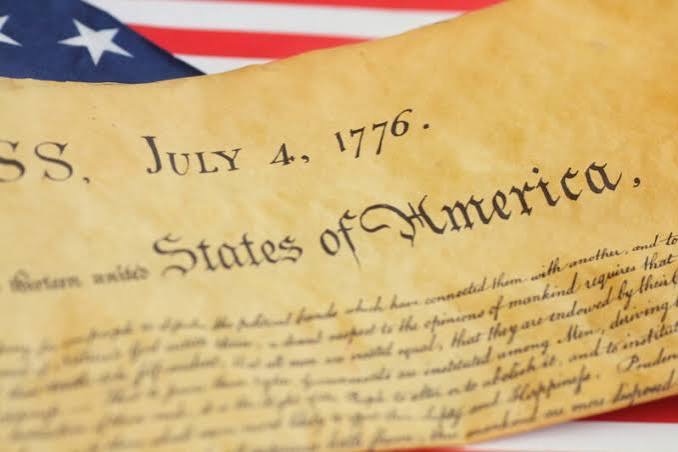
It was a Dunlap Broadside — one of the very first printed versions of the Declaration of Independence, run off the press by Philadelphia printer John Dunlap on the night of July 4th, 1776, to be distributed to General Washington's army and sent to the assemblies of each colony. Historians believe Dunlap printed approximately 200 copies that night. As of the last known count, approximately 26 are confirmed to still exist.
The man sold it at Sotheby's in the year 2000. Final price: $8.14 million.
In 2008, another copy surfaced — found in the archives of a records office in England, apparently taken home as a souvenir by a British officer during the Revolutionary War. History keeps turning up in the last place anyone thought to look.
Chapter FiveNew Jersey Had a Front-Row Seat
The Declaration didn't stay in Philadelphia long. Copies were sent out immediately — and the first states to receive official copies were New Jersey and Delaware, on July 5, 1776, the day after Congress adopted it.
New Jersey Was First. And It Cost Some of Them Everything.
The first public reading of the Declaration in New Jersey took place in Trenton on July 8, 1776 — the same day it was read aloud in Philadelphia, Easton, and other colonial centers. Five New Jersey men signed it. Their names deserve to be said out loud.
- Richard Stockton of Princeton — a lawyer and one of the most respected men in the colony. Captured by British Loyalists in November 1776, thrown in a British prison, forced under brutal conditions to sign a statement renouncing his support for independence. He never fully recovered. He died in 1781 at 51, his health broken.
- John Witherspoon of Princeton — the only active clergyman to sign the Declaration, and the president of what is now Princeton University. His son James was killed in the Battle of Germantown.
- Francis Hopkinson of Bordentown — a lawyer, poet, and designer who also contributed to the design of the first official American flag layout.
- John Hart of Hopewell — while Hart was away serving in Congress, British forces ransacked his farm, seized his livestock, and scattered his family. His wife was dying. His thirteen children went into hiding. Hart spent months evading capture across New Jersey, sleeping in forests and barns, while his farm fell apart and his wife died. He never saw it whole again.
- Abraham Clark of Elizabethtown — known as "The Poor Man's Counselor" for representing clients who couldn't afford legal fees. Two of his sons were captured by the British and held aboard the prison ship Jersey in New York Harbor, where thousands of American prisoners died of disease, starvation, and neglect.
Chapter SixThe Facts That Sound Made Up
These are all real. Verified. You can look every one of them up.
Six men signed both the Declaration of Independence and the United States Constitution — two separate founding documents, written eleven years apart. Those six were Benjamin Franklin, Roger Sherman, Robert Morris, George Clymer, George Read, and James Wilson. Franklin, who was essential to both, was 70 when he signed the Declaration and 81 when he signed the Constitution. He literally could not stop being historically significant.
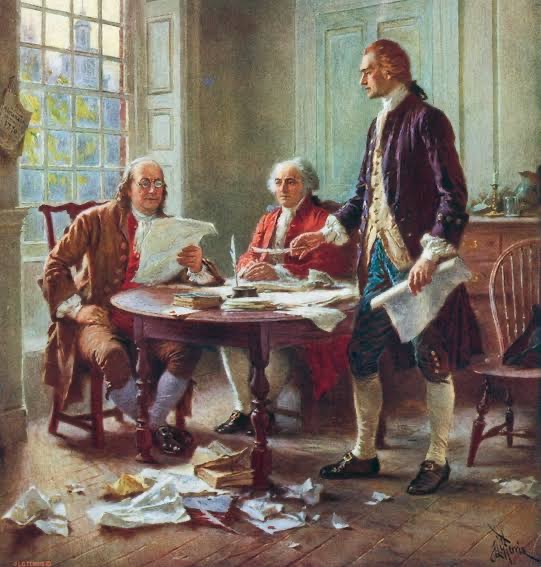
Franklin was asked to write the Declaration. He turned it down. The task fell to Thomas Jefferson, who was 33 years old at the time. Jefferson wrote the first draft in approximately 17 days, working in a rented room in Philadelphia. Congress then edited it — substantially. Jefferson resented it for the rest of his life. They cut his most powerful passage entirely (more on that below).
The oldest signer was Franklin at 70. The youngest was Edward Rutledge of South Carolina, at 26. The median age of the signers was in the mid-40s. These were not ancient statesmen. Many of them were closer in age to college seniors than to grandfathers. They were risking everything at an age when most people are still figuring out what they want to do with their lives.
After Pearl Harbor, the U.S. government secretly moved the Declaration and the Constitution to Fort Knox. In December 1941, with the country newly at war and Washington potentially vulnerable to attack, both documents were quietly packed up, placed under armed guard, transported by train to Kentucky, and stored in the gold vault at Fort Knox — where they stayed until 1944. The government said nothing about it publicly. The most important documents in American history spent three years in a gold vault in Kentucky while the world was on fire.
Chapter SevenThe Coincidence That Gives Historians Chills
John Adams and Thomas Jefferson were two of the most consequential Americans who ever lived. They were also, for extended stretches of their careers, bitter rivals — ideological opposites who at various points in their lives referred to each other in terms that would embarrass a modern social media comments section.
They reconciled in old age. Through letters — hundreds of them — they debated, reminisced, criticized each other, praised each other, and slowly rebuilt something like friendship across the miles between Massachusetts and Virginia. The Adams-Jefferson correspondence is one of the great literary treasures of the founding era.
And then, on July 4, 1826 — the 50th anniversary of the Declaration of Independence, to the exact day — both men died.
Two Founders. One Day. Fifty Years Later.
Thomas Jefferson died at Monticello in Virginia at approximately 12:50 PM. John Adams died at his home in Quincy, Massachusetts at approximately 6:20 PM — unaware that Jefferson had already gone. Adams reportedly murmured near the end, "Jefferson still lives." He was wrong. Jefferson had passed five hours earlier, 500 miles to the south, on the same day, in the same year, on the exact 50th anniversary of the document they had both made possible.
James Monroe, the fifth President, the last of the Founders to hold the office, also died on July 4th — in 1831, exactly five years later.
Three of the first five presidents of the United States died on the Fourth of July. Historians have been trying to make complete sense of this for nearly two centuries. They haven't.
Chapter EightThe Part We Don't Skip
Jefferson's original draft of the Declaration contained a passage that does not appear in the version you know. It was a long indictment of King George III — specifically, an accusation that the Crown had imposed the slave trade on the colonies against their will and "captivated & carried" people into slavery in violation of their natural rights.
Congress cut it. Entirely. To hold the southern colonies in the coalition — and to avoid alienating northern merchants who profited handsomely from the slave trade — the delegates eliminated the anti-slavery language before the document went to press. The same men who wrote "all men are created equal" could not agree to say anything, in their final published document, about the institution that denied that equality to roughly one in five people living in the colonies at the time.
Roughly one in five colonists remained loyal to the British Crown during the Revolution. The American founding was not a unanimous uprising of a unified people against a common oppressor. It was an argument — sometimes violent — about whether to break from Britain at all, and what kind of country to build in the aftermath. That argument has never fully ended. In many ways, it is still ongoing. That is not a reason to despair. It may be the whole point.
On July 5, 1852, Frederick Douglass gave a speech in Rochester, New York. He had been invited to speak at a Fourth of July celebration. He accepted. And then he asked the audience a direct question: "What, to the American slave, is your Fourth of July?"
He answered it. Completely, rigorously, and without comfort. The speech is available in full from the Library of Congress. It is 174 years old and it is worth reading today.
Chapter NineThe Quiet Miracles We've Stopped Noticing
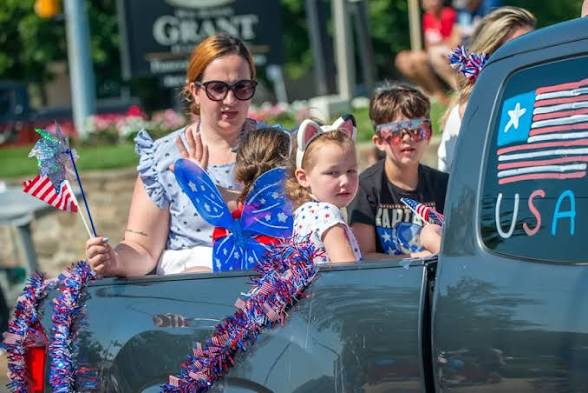
Here is what 250 years has quietly built — so slowly, so incrementally, that most Americans have forgotten to be astonished by it.
The First Amendment. You are allowed, right now, to write an article criticizing the President of the United States. You can post it publicly. You can read it aloud in a public square. You will not be arrested for it. You will not be jailed. That is not true in most countries that have ever existed on this planet — including countries that considered themselves advanced and civilized at the time. It has been true here for 235 years.
Water from the tap. You turn on a faucet. Clean water comes out. This was not always something that happened anywhere. It is still not something that happens everywhere on Earth. For most of human history, drinking water killed people regularly. Here, largely, it doesn't.
National parks. In 1872, the United States created Yellowstone — the world's first national park. The idea was radical: that land of spectacular natural value should be preserved not for a monarch or a private owner, but held in trust for the public permanently. That idea has since spread to every continent on Earth. It started here.
GPS. The Global Positioning System is a United States military satellite network. The government makes it available — free of charge — to every person on the planet. Farmers in Kenya use it to plant crops. Fishermen in Indonesia use it to navigate. You used it to drive here today. It costs the user nothing. It was given to the world by this country.
The ballot. Two hundred and fifty years. Dozens of presidential elections. The most powerful office in the world has transferred peacefully, through the counting of votes, over and over again. Not every election has been clean. Not every transfer has been smooth. The system has been tested — badly, at times. But it keeps going. That is not ordinary. That is, historically speaking, extraordinary.
Chapter Ten250 Years, and Still Being Written
The men who wrote the Declaration of Independence were not gods. They were lawyers and farmers and merchants and politicians — most of them wealthy, most of them white, many of them aware with varying degrees of discomfort that the words they were putting on paper did not describe the country they were actually living in.
Jefferson knew it. He wrote "all men are created equal" in a house where enslaved people cooked his food, maintained his estate, and had no vote in the matter. Adams knew it. Franklin knew it. They wrote the ideal anyway. Whether that makes them hypocrites, or visionaries, or both, is a debate historians have been having for 250 years and have not resolved — because it's not the kind of question that gets resolved. It's the kind of question that keeps the country honest.
What the founders left behind was not a finished country. They left behind a set of claims — about human equality, about natural rights, about what government is supposed to exist for — that the people who came after them have been trying, failing, and trying again to live up to ever since. Sometimes making real progress. Sometimes losing ground they thought they'd already won. Always arguing about it, loudly and publicly, which is itself exactly what the First Amendment was designed to protect.
Two hundred and fifty years in, we're still at it.
That might be the most American thing of all.
Sources & Verification
Facts in this article were verified against the National Archives (archives.gov), the Library of Congress (loc.gov), the National Constitution Center (constitutioncenter.org), and the Second Continental Congress historical record. The Dunlap Broadside story is documented by Sotheby's auction records and the American Antiquarian Society. The Adams-Jefferson death dates and correspondence are from the Massachusetts Historical Society and Monticello.org. Frederick Douglass's speech "What to the Slave Is the Fourth of July?" (delivered July 5, 1852, Rochester, NY) is held in the Library of Congress. The Fort Knox evacuation of the founding documents is documented by the National Archives. The five NJ signers' biographies are sourced from the New Jersey State Archives and the National Archives.