Drive the back roads of Salem County on a gray November afternoon and you will pass fields and pines that look, at a glance, like nothing much happened here. They are wrong, those fields. In 1739, in what is now Alloway Township, a German immigrant named Caspar Wistar built a glassworks in the woods — and in doing so lit a furnace that would burn, in one form or another, across South Jersey for the better part of three centuries.
Wistar was a Philadelphia brass-button maker and land speculator with an eye for what the land offered. And South Jersey offered exactly what glass demands: white sand and clay underfoot, and woods standing ready to feed the furnaces. He brought over four skilled German glassblowers, built a village around the operation, and called it Wistarburgh. Historians count it as the first truly successful glass factory in the colonies. By the 1750s it was a working village, turning out bottles and window panes and the occasional piece of tableware.
Franklin’s glass
It also, in a detail I never tire of, served science. When a Philadelphia printer named Benjamin Franklin needed glass tubes and globes for his experiments with electricity in the 1740s, it was Wistar’s South Jersey furnace that supplied them. The next time you picture Franklin and his key and his storm, picture Salem County sand in his hand.
Wistarburgh did not long outlive the Revolution. Caspar died in 1752; his son Richard carried it on, but the war years and the thinning woods brought it down. But the men who had learned the trade in those woods carried it outward like embers. One of them, Solomon Stanger, left with his family around 1780 and founded a works of their own up in Gloucester County. The community that grew around it took the obvious name. We call it Glassboro still.
We call it Glassboro still.Henry Whitaker
Towns built on sand
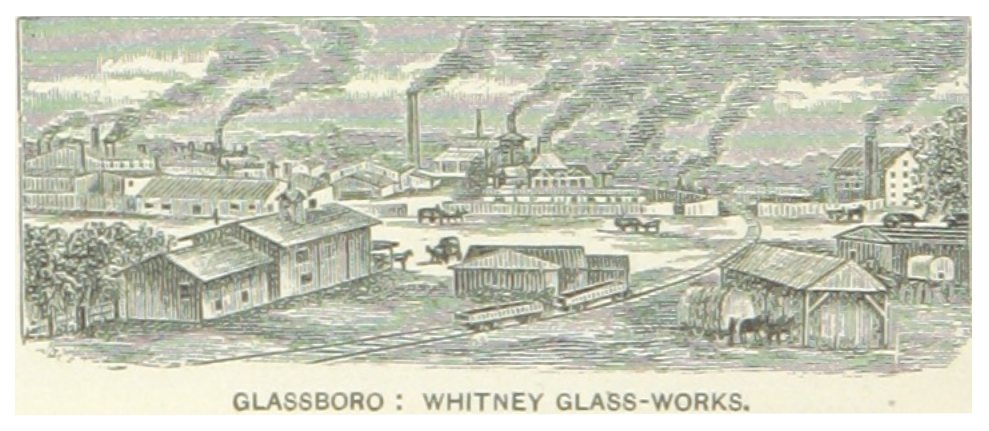
That is the thing about this industry — it did not stay in one place, it seeded towns. Glassboro became a true center, home eventually to the Whitney Glass Works, bought by the Whitney family in 1838 and employing more than a thousand people at its peak. Down in Millville, the furnaces ran from the early nineteenth century into our own. In 1888 a Millville pharmacist named Dr. Theodore Corson Wheaton started a glassworks to make medicine bottles, and the T.C. Wheaton name grew into one of the great American glass concerns, supplying the medicine bottles and laboratory glass the whole country relied on.
Still burning in Millville
Why does any of this belong in a November newspaper? Because the evidence is still here, and it is still open. In Millville, what began in the 1960s as one Wheaton grandson’s effort to honor the family trade became Wheaton Village, and today it is WheatonArts, home to the Museum of American Glass and to glassblowers who still gather molten glass on the end of a pipe the way Wistar’s Germans did in 1739. You can stand there and watch a thing be made from sand and fire, the oldest South Jersey story there is.
We talk a great deal lately about what this region was before the strip malls and the turnpike exits. Here is a plain answer: it was the cradle of an American industry. The sand beneath our feet built the bottles in our grandparents’ medicine cabinets and the globes in Franklin’s hands. The fields look like nothing much happened here. Everything did.
Based on reporting from The Encyclopedia of Greater Philadelphia, WheatonArts and the Heritage Glass Museum.
More South Jersey History
Henry Whitaker digs into the stories under our feet every week.
Read More Local News →