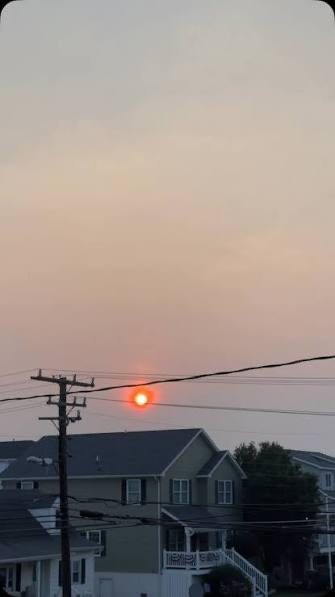
ATLANTIC CITY — If you looked up this week and thought the sky over the boardwalk had gone the wrong color — a flat, yellowed haze where the July blue should be — you weren’t imagining it, and it isn’t the ordinary summer humidity. It’s smoke, and it traveled a very long way to reach your umbrella.
More than 800 wildfires are burning across Canada right now, including roughly 100 in Ontario alone, and the smoke from those fires has been drifting south into New Jersey and the rest of the Northeast. It’s the same phenomenon that turned our skies an eerie orange a few summers back, and it has prompted the New Jersey Department of Environmental Protection to issue a Code Red air quality alert — the level that means the air is unhealthy for everyone, not just sensitive groups.
What the haze actually is
Here’s what that actually means for a family trying to enjoy the Shore. The problem with wildfire smoke isn’t just that it looks unpleasant; it’s the fine particle pollution riding in it. Those particles are small enough to get deep into your lungs, and even for healthy people they can cause coughing, chest tightness, shortness of breath, stinging eyes, a scratchy throat, and that dragged-out, dizzy fatigue you can’t quite explain. On a Code Red day, that’s true whether you feel it coming or not.
Who needs to be careful
Some folks need to take it more seriously than others. If you or your kids have asthma, if you’re pregnant, if you’re managing a heart or lung condition, or if you’re caring for an older parent or a very young child, this is a day to be cautious rather than heroic. That doesn’t mean the whole beach trip is ruined — it means reading the day honestly. Keep the long, strenuous stretches outdoors shorter than usual. Take breaks in air conditioning. Skip the noon soccer game on the sand and save the big activity for a clearer afternoon.
Two practical notes
Two practical notes worth having on hand. First: the mask in your junk drawer matters here. An N95 or KN95 will actually filter out smoke particles; a loose cloth or surgical mask won’t do much against them. Second, and simplest: you don’t have to guess. AirNow.gov gives you the current air quality for your exact area, updated through the day, so you can check the number before you load the car instead of finding out the hard way on the beach.
It just means checking the air the same way you’d check the tide chart — one more number that tells you when to go, and when to give it an hour.Max Cedar
The good news, if you want some, is that smoke like this tends to move. Air quality along the coast can shift within a day as the winds change, so a hazy, hard-to-breathe morning can give way to a cleaner evening. This isn’t a reason to write off the rest of the week — it’s a reason to stay flexible and let the conditions, not the calendar, decide your plans.
The Shore has weathered nor’easters, heat waves, and more than a century of whatever the sky decided to throw at it. A few hazy days from a fire a thousand miles away won’t change what this coastline means to us. It just means checking the air the same way you’d check the tide chart — one more number that tells you when to go, and when to give it an hour.
Based on reporting from the New Jersey Department of Environmental Protection, NJ 101.5, NJ Spotlight News, and AirNow.gov. Air quality conditions as of July 22, 2026. The Neighborhood Gazette covers South Jersey at neighborhoodgazette.town.
Check Before You Go
On a Code Red day, AirNow.gov has your exact-area air quality, updated hourly. Stay flexible, keep the N95 handy, and let the conditions decide.
More Shore Coverage →