NATIONAL PARK — Stand on the bluff at Red Bank Battlefield on a gray October morning, with the Delaware sliding by below you and the Philadelphia skyline hazy on the far bank, and it is easy to forget that this quiet 44-acre park was once the hinge on which a war briefly turned. But it was. On October 22, 1777 — 249 years ago next week — a few hundred Continental soldiers held this ground against a Hessian force several times their size, and sent the survivors reeling back into the woods. In this year of all years, the 250th anniversary of American independence, it is a story worth walking out to the river to remember.
The fort that stood here was called Fort Mercer, named for Brigadier General Hugh Mercer, who had been killed months earlier at Princeton. Together with Fort Mifflin directly across the water in Pennsylvania, it did one essential job: it kept the British from using the Delaware to supply their newly occupied Philadelphia. As long as the two forts held, General Howe’s army sat in a captured capital it could not easily feed. The British wanted Fort Mercer gone, and they sent Colonel Carl von Donop with well over a thousand Hessians — professional soldiers, the most feared infantry in the world — to take it.
The men behind the earthworks
They did not take it. Behind the earthworks stood Colonel Christopher Greene and his Rhode Island Continentals, whose Rhode Island regiments included Black and Native American soldiers serving side by side — a detail the official histories long glossed over and that a marker on the grounds now, rightly, tells. Greene’s men were ready. When von Donop’s columns came on, they were cut to pieces in front of the ditch. The Hessians suffered hundreds of casualties. Von Donop himself fell mortally wounded and died days later in the hands of the Americans he had come to destroy.
A run from Haddonfield
And they were ready, the story goes, because of a hunter from these very backwoods. The day before the attack, a young man named Jonas Cattell overheard Hessian soldiers in Haddonfield talking through their plan. Cattell knew this country the way only a local hunter can, and he ran — ten miles, from Haddonfield to Red Bank — to warn Greene that the enemy was coming. Whatever the legend has added over two centuries, the bones of it hold: a neighbor who knew the ground ran until his lungs gave out so that other men would not be caught unprepared. We honor generals with statues. It is worth remembering that the Revolution also turned on people like Jonas Cattell, who simply decided that warning was worth the running.
We honor generals with statues. It is worth remembering that the Revolution also turned on people like Jonas Cattell, who simply decided that warning was worth the running.Henry Whitaker
The Heroine of Red Bank
There was a heroine here, too, and she did not fire a shot. The James and Ann Whitall House, a handsome Georgian home built in 1748 that still stands on the grounds, became a field hospital in the aftermath. Ann Cooper Whitall, a Quaker farm wife, stayed and tended the wounded — American and Hessian alike — earning herself the enduring title “the Heroine of Red Bank.” There is a whole theology in that choice, to nurse the very men who had just tried to overrun your home, and it is as much a part of this place as the cannons.
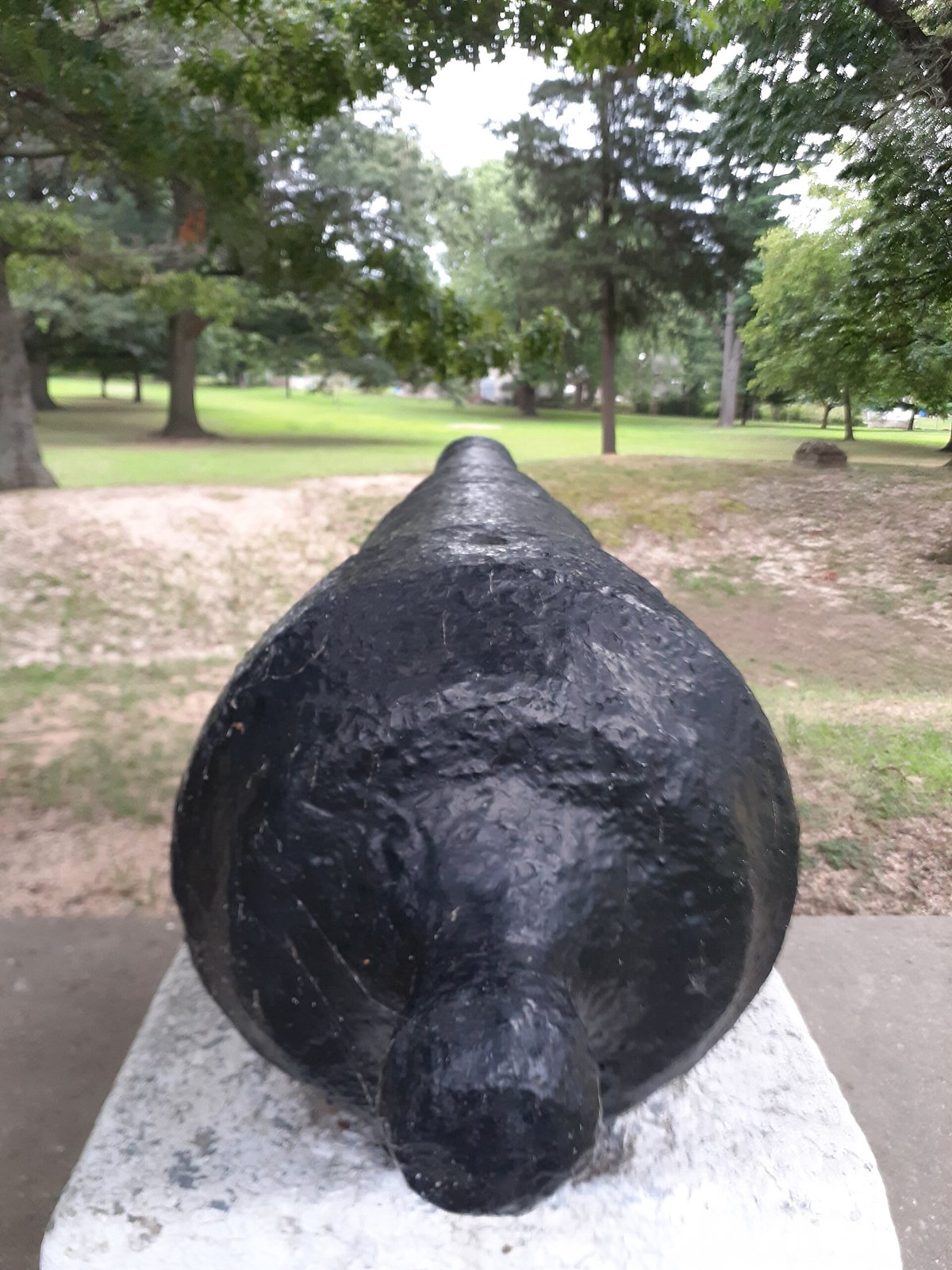
Some of the guns from that fight are still here, by the way. Cannons on display were raised from the wrecks of HMS Augusta and HMS Merlin, British warships that ran aground and were destroyed during the river fighting. You can see a preserved section of the chevaux-de-frise, the spiked underwater barriers that helped choke the Delaware, and the tall 1906 monument that marks the battle, along with memorials to Greene and, in a gesture of old-fashioned honor, to von Donop himself.
Walk it this month
Each year, around the anniversary, the Gloucester County parks system and local history groups bring the ground back to life with an 18th Century Field Day — reenactors, hearth cooks turning out the food of the period, tours through the Whitall House, and, in years past, a Jonas Cattell Run whose finishers crossed the line where the real Cattell once arrived, out of breath and just in time. It is the best kind of history: not kept behind glass, but walked, run, and tasted on the spot where it happened.
If you have never made the short drive to National Park, make it this month. Bring the kids. Stand on the bluff, look across at the city those earthworks helped protect, and let a teenage hunter’s ten-mile run remind you what this country asked of ordinary people, and what ordinary people gave.
Based on reporting from the Historical Marker Database (HMdb.org), Wikipedia, Crossroads of the American Revolution, and Gloucester County Parks.
More South Jersey History
The Gazette is marking America’s 250th one South Jersey story at a time.
Read More Local News →