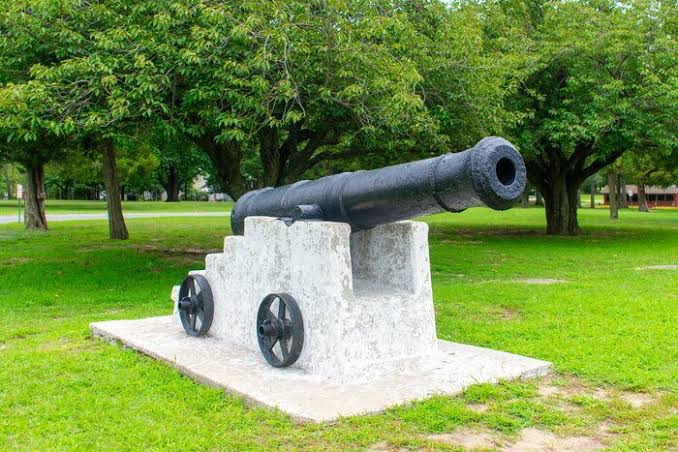
You can drive past it in a minute. A quiet green park on a bluff over the Delaware, in a Gloucester County borough that took its name from the very thing I’m about to tell you about. Kids fly kites there. People walk dogs. And under all that ordinary calm, the ground at Red Bank Battlefield is holding one of the most improbable stories of the American Revolution — a story that, in this 250th year of the nation, deserves to be told again to anyone who’ll stand still long enough to hear it.
Let me take you back to October 22, 1777. The Revolution was going badly. Philadelphia — the capital, the beating heart of the whole rebellion — had already fallen to the British in September. The one thing keeping British General Howe from fully supplying his occupied city was the Delaware River, and the one thing keeping the British off the Delaware was a pair of forts: Fort Mifflin on the Pennsylvania side, and here, on this New Jersey bluff, an earthwork called Fort Mercer.
Four hundred against two thousand
The Hessians were German soldiers hired by the Crown, professional and feared, and on that October day roughly two thousand of them under Colonel Carl von Donop marched on Fort Mercer expecting to roll over it. Inside the fort were about four hundred Continental soldiers — a Rhode Island regiment under a young colonel named Christopher Greene, a cousin of Washington’s more famous general Nathanael Greene. On paper, it was not a battle. It was a formality. The paper was wrong. Greene’s men had done something clever with the fort’s design, and when the Hessians came on in their disciplined lines, certain of victory, they marched into a killing ground. The assault broke apart against the earthworks. Von Donop himself fell, mortally wounded. When the smoke cleared over the Delaware, four hundred Americans had thrown back an army five times their size — one of the lopsided victories of the entire war, and it happened here, on ground South Jersey can walk to on a Sunday afternoon.
Ann Whitall at her spinning wheel
But the detail I can never get past belongs to a woman named Ann Whitall. The Whitalls were a Quaker family whose handsome brick house still stands on the battlefield, the James and Ann Whitall House, built in 1748. Quakers are pacifists; the Whitalls wanted no part of anyone’s war. When the armies came, the family was urged to flee. Ann Whitall, by the account that has come down to us, refused to leave, and sat at her spinning wheel as the cannon fire shook her home — until a shot came through the wall, and only then did she move her wheel to the cellar and keep working. And when the fighting ended and the wounded came, Hessian and American alike, Ann Whitall opened her home and nursed them. The pacifist who wanted no war spent it caring for the broken bodies it produced, and asked no man which side he’d bled for.
There is the grand history — the strategy, the river, the forts, the generals — and then there is Ann Whitall at her spinning wheel, refusing to let a war interrupt her work and then refusing to let it harden her heart. Both are true. Both are ours.Henry Whitaker
This is the year to remember all of it. The nation is marking its 250th anniversary in 2026, and New Jersey — which saw more Revolutionary skirmishes on its soil than any other state, the “Crossroads of the American Revolution” — has thrown itself into the commemoration through RevolutionNJ, the partnership between the New Jersey Historical Commission and the Crossroads nonprofit. The scale model of Fort Mercer is still there. The Whitall House is still there. The river is still there. Go stand on the bluff before the year is out, put a hand on a 278-year-old brick wall, and understand that the calm we take for granted was paid for on this exact ground. The ground remembers. The least we can do is remember with it.
Based on reporting from the New Jersey Historical Commission, Crossroads of the American Revolution / RevolutionNJ, Gloucester County, Visit South Jersey, and historical accounts of the Battle of Red Bank.
More South Jersey History
In the nation’s 250th year, the Gazette is walking the ground where freedom was won — right here.
Read More Local News →