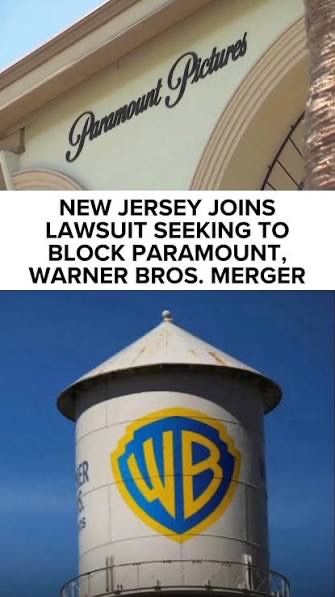
TRENTON — It is not every day that a decision made in a federal courtroom in Northern California turns on an argument advanced, in part, by the State of New Jersey. But that is where things stand this week, and South Jersey readers deserve to understand why their state government has inserted itself into one of the largest media deals in American history.
The facts first
Paramount Skydance Corp. has proposed to acquire Warner Bros. Discovery Inc. in a deal valued at roughly $110 billion. New Jersey Attorney General Jennifer Davenport joined eleven other state attorneys general in a federal lawsuit seeking to block it, arguing the combination violates the Clayton Act — the federal antitrust law that prohibits acquisitions likely to substantially reduce competition or create a monopoly. On Monday, a judge in the U.S. District Court for the Northern District of California issued a temporary restraining order, freezing the merger for at least two weeks while the court weighs a longer injunction. The Attorney General’s office called it a critical early win. Notably, the states brought this action even as the U.S. Department of Justice took a different posture — meaning New Jersey and its partners are pressing the case largely on their own.
Why is my state in this?
Set aside, for a moment, whether you think the merger is good or bad. The more useful question for a taxpayer is the one I always come back to: why is my state spending its legal resources on this, and what is the argument on each side?
For once, a $110 billion question has a New Jersey signature on it.Grace Monroe
The states’ case
The states’ case is straightforward. They contend that folding two of the largest content producers in the country into a single company would give that company too much control over what gets made and what it costs — leading, in their words, to higher prices, lower quality, and less content for consumers. In an era when most households pay for several streaming services, “higher prices and less choice” is not an abstraction. It is a monthly bill. The attorneys general are casting themselves, essentially, as consumer advocates for every family paying for television.
The other side
The other side of the ledger deserves an honest hearing too, because it always does. Companies pursuing mergers of this size typically argue that scale is precisely what lets them compete — that combining resources is how a legacy studio survives against the deep pockets of the biggest technology platforms, and that a bigger, healthier company can invest more in content, not less. Supporters of the deal would also note that the federal antitrust authorities themselves did not move to block it, which they would read as a signal that the competitive concerns are overstated. A restraining order, they would remind us, is a pause, not a verdict.
A New Jersey angle you shouldn’t miss
There is also a New Jersey angle that a reader here should not miss. This is a state actively courting the film and television industry, pouring hundreds of millions into incentives to make itself a production hub. A merger that concentrates control over who greenlights projects could, at least in theory, shape how much work flows to the very soundstages New Jersey is betting its economic future on. The state’s interest in a competitive content market is not purely on behalf of consumers at the checkout — it may also be on behalf of the crews and studios it is working to attract.
I will not tell you how this should come out; that is for the court, and reasonable people will land in different places on whether this merger helps or harms. What I will tell you is that the stakes are real and close to home in a way these distant corporate stories usually are not — this one touches both the bill you pay for television and the industry your state is trying to build. New Jersey has taken a side and won the first round. The next hearing will tell us whether that win holds, or whether it was only a two-week reprieve.
Based on reporting from the New Jersey Office of the Attorney General, NJBIZ, 6abc Philadelphia, CNBC, and Variety. The Neighborhood Gazette covers South Jersey at neighborhoodgazette.town.
A $110 Billion Question, With a Jersey Signature
New Jersey has taken a side and won the first round. We’ll cover the next hearing — and what it means for your TV bill and the industry the state is building.
More Politics →