You can pour a billion dollars of concrete and steel into a soundstage in eighteen months. Building the workforce to fill it takes longer, and it’s the part of New Jersey’s film boom nobody puts on a billboard. So let me make the case that the most important infrastructure being built right now isn’t a building at all. It’s the pipeline of people — and the digital tools connecting them to the work.
The problem in plain terms
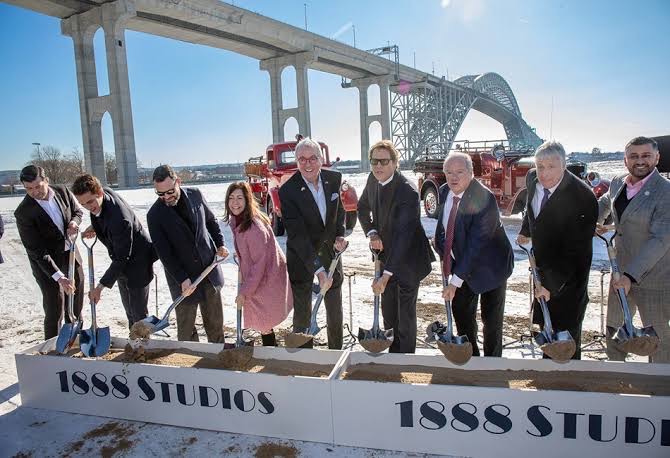
Here’s the problem in plain terms. A single modern production employs hundreds of people across dozens of specialized crafts — gaffers, grips, boom operators, colorists, set carpenters, production coordinators, transportation captains. When three or four major studios come online in a compact state more or less at once — Netflix at Fort Monmouth, Lionsgate in Newark, 1888 Studios in Bayonne with Paramount as a tenant — the demand for that skilled labor arrives faster than any region can train it from scratch. The tax credits that lured the studios are the easy lever to pull. The hard question is whether there’s a trained crew standing by when the director calls “action.”
The connective tissue
This is where the less glamorous technology comes in, and where I think South Jersey readers should pay attention. Platforms like Hollywood East Media have launched specifically to knit the East Coast film community together — a digital marketplace connecting productions with jobs, casting, and local crew. Think of it as the connective tissue an industry needs to function: a way for a lighting tech in Camden County to find out that a production in Monmouth County needs exactly her skills next month, without her having to know somebody who knows somebody. For decades, breaking into film work ran almost entirely on personal connections. Software that replaces “who you know” with “what you can do” is quietly one of the most democratizing things that can happen to a local labor market.
The demand is real
The early signals suggest the demand is real, not hypothetical. In the first quarter of 2026, New Jersey posted a 45 percent increase in film count and a 37 percent rise in production spending — at the same time that production nationally was declining. And the state’s incentive program is explicitly wired to reward hiring, offering bonuses of up to 4 percent tied to workforce development.
The money follows the productions, but the productions follow the crews.Ethan Brooks
The genuine test
I want to be straight about the risk, because I always am. A digital platform is only as good as the training feeding people into it. You can build the best job-matching app in the world, but if there aren’t enough qualified electricians and carpenters and coordinators in the region to match, all you’ve built is a very efficient way to display job openings nobody local can fill. The genuine test of whether “Hollywood East” becomes a durable industry or a temporary tax-credit mirage is whether South Jersey’s community colleges, trade programs, and unions can turn out skilled crew as fast as the soundstages can turn out square footage. Technology can connect people to opportunity. It cannot, by itself, create the skills.
Why it matters down here
But that’s also exactly why this moment is worth watching closely from down here. The studios are clustering up north, but skilled trades and crew can live anywhere within driving distance — and South Jersey is full of exactly the kind of tradespeople these productions need. If the training pipelines and the matching platforms mature together, a kid in Gloucester County could build a real film career without ever moving away. The steel is going up fast. The real innovation will be whether we can put our own neighbors to work inside it.
Based on reporting from NJBIA, Jersey Digs, ROI-NJ, and Hollywood East Media. The Neighborhood Gazette covers South Jersey at neighborhoodgazette.town.
The Pipeline Is the Real Infrastructure
Studios are the easy part. The real test is training and connecting South Jersey crews to the work. We’ll follow the pipeline.
More Coverage →