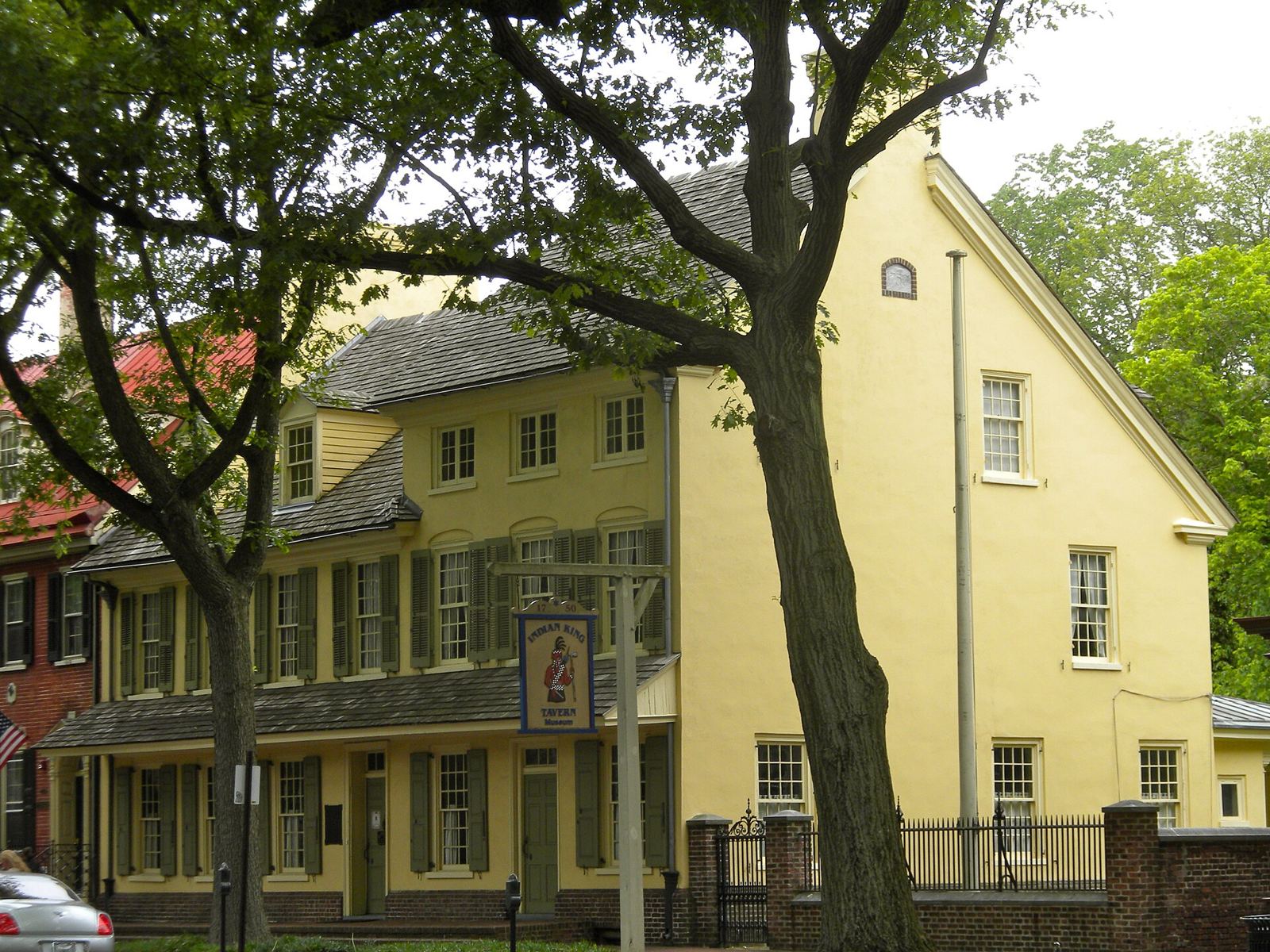
HADDONFIELD — Walk the brick sidewalks of Kings Highway on a cool October afternoon, past the boutiques and the coffee shops and the steady foot traffic of one of South Jersey’s prettiest downtowns, and you will come to a modest old building that asks nothing of your attention. Most people pass it without a glance. They shouldn’t. Inside those walls, in the frightened winter of 1777, a handful of men sat down and did the quiet, dangerous work of turning a rebellious colony into a state.
The Indian King Tavern was already old by then. A Quaker merchant and ship owner named Mathias Aspden bought the property in 1745 and had the building completed by 1750, when Haddonfield was a crossroads of taverns and farm wagons rather than a destination. Aspden’s son, a Loyalist, sold it off as the Revolution closed in; by 1777 it had passed to the innkeeper Hugh Creighton. It was a tavern in the full eighteenth-century sense — a place to eat, drink, sleep, trade news, and, when the moment demanded, to govern.
The room upstairs
That moment arrived when fighting in the Delaware Valley forced the New Jersey Legislature out of its usual quarters and sent it looking for a safe room. It found one on the tavern’s second floor. There, the General Assembly and the Legislative Council conducted the business of a government still deciding whether it would survive the year. They read the Declaration of Independence into the official minutes. They enacted a law accepting its terms. And it was here, by the traditional account, that the body adopted the Great Seal of the State of New Jersey — the three plows and the goddesses of Liberty and Ceres that still sit at the top of every official document the state produces today.
It is worth pausing on how precarious all of this was. These were not men performing statehood for the cameras. The British held nearby ground, the outcome of the war was genuinely in doubt, and the simple act of signing your name to the rebellion was a wager with your life. That they chose a working tavern in Haddonfield to do it — not a capitol, not a grand hall, but a room above a barroom — is the most New Jersey thing imaginable, and I mean that as the highest compliment.
That they chose a working tavern in Haddonfield to do it — not a capitol, not a grand hall, but a room above a barroom — is the most New Jersey thing imaginable, and I mean that as the highest compliment.Henry Whitaker
A second life
The building’s second life is nearly as instructive as its first. By the turn of the twentieth century, the Indian King had become the object of a preservation campaign, and in 1903 the state purchased it — making it the first state-owned historic site in New Jersey, the seed from which the entire state historic sites system would grow. Restorers stripped away the accretions of a century and a half and returned the structure to its original lines. It was added to the National Register of Historic Places on December 18, 1970.
Visit today and you can climb those same stairs for free; tours of the first and second floors cost nothing, a rarity worth savoring. Not everything has survived intact — the interior furnishings are period reproductions rather than originals, a concession to budgets that preservationists everywhere will recognize. And the cellar remains closed to the public and largely unexplained, its odd layout and passageways the subject of local legend. (One such legend, that Dolley Madison danced at the tavern, was repeated on mid-century tours and has since been politely dispelled. History has enough true marvels here without borrowing one.)
Why it matters now
I raise all of this now because we are living through a season of anniversaries. As the nation marks its 250th and New Jersey takes its own measure of the Revolution, the temptation is to look toward the grand sites — the battlefields, the crossings, the monuments. Do. But do not overlook the smaller rooms where the less cinematic work got done, because that work is the reason the battlefields meant anything. A state is not born on a parade ground. Sometimes it is born upstairs, in a tavern on Kings Highway, by men who did not know whether they would live to see it grow.
The next time you are in Haddonfield, give the little building a second look. Then go inside. It costs nothing but an afternoon, and you will walk out standing in a slightly older, slightly deeper version of the state you already call home.
Based on reporting from the New Jersey Division of Parks and Forestry (NJDEP), the National Park Service, and public historical records.
More South Jersey History
There’s a story in every old building around here. We’ll keep telling them.
Read More Local News →