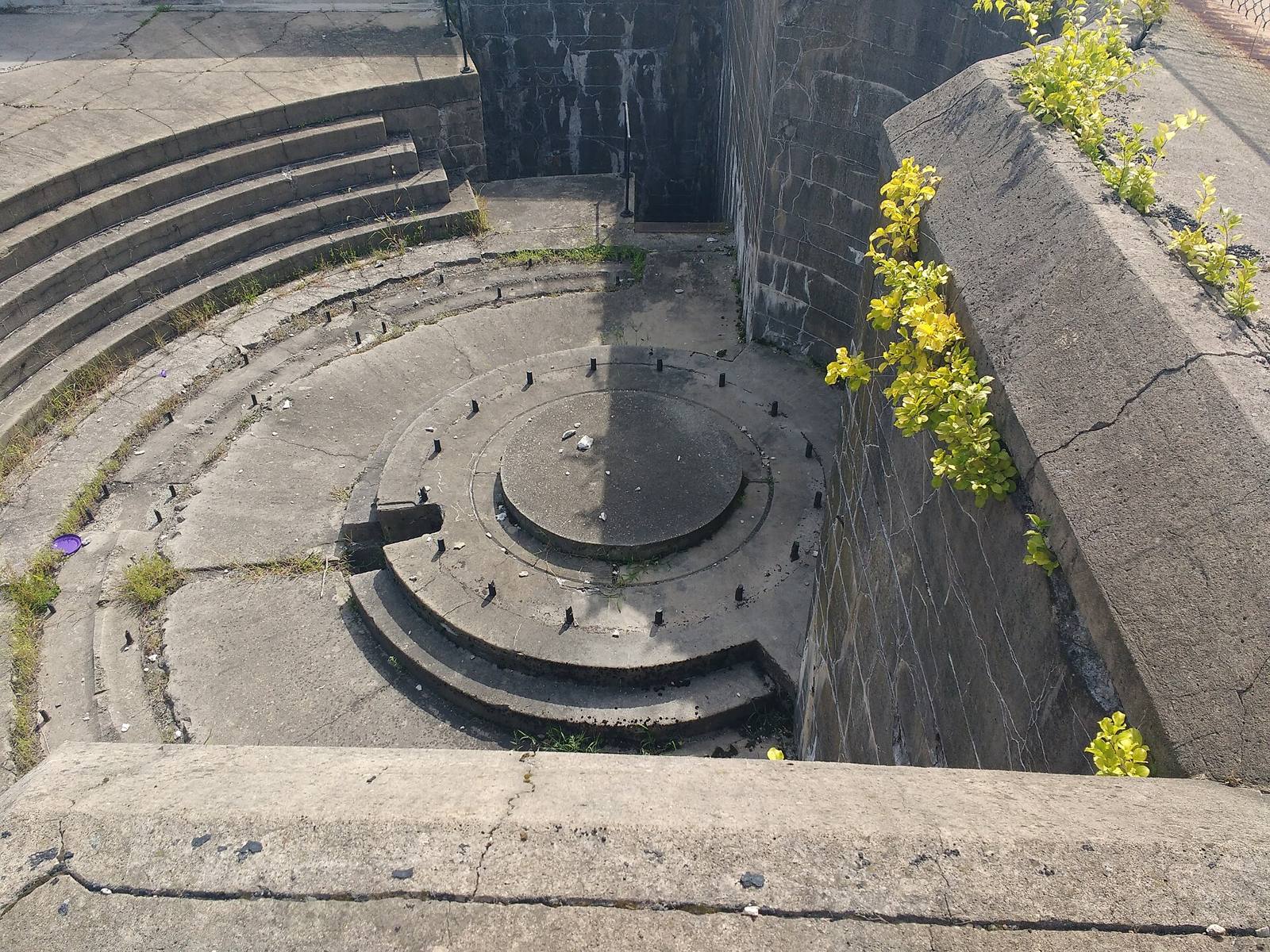
PENNSVILLE — Stand on the earthen rampart at Fort Mott on a gray November afternoon, with the Delaware River sliding past wide and silent below you, and you are standing on one of the strangest monuments in South Jersey: a fortress built for a war that never came to it. The great disappearing guns are gone now, shipped off decades ago to Hawaii, to Newfoundland, to the Western Front. The concrete emplacements remain, cold and vast, honeycombed with magazines and galleries, staring across the water at a Delaware shore that no enemy fleet ever tried to pass. In all its years of service, Fort Mott fired its guns only in practice. That is not failure. In the peculiar arithmetic of coastal defense, it is the highest form of success — the fort did its job precisely by never having to do its job.
This week, as the country pauses for Veterans Day, it is worth driving down Route 295 into Salem County to understand what this place was and why the men who kept it mattered, even though no battle was ever named for them.
In all its years of service, Fort Mott fired its guns only in practice.Henry Whitaker
One point of a triangle
Fort Mott was one point of a triangle. To defend the approaches to Philadelphia and the shipyards and refineries up the Delaware, the U.S. Army built a three-fort system: Fort Mott here on the New Jersey bank, Fort Delaware on Pea Patch Island out in the middle of the river, and Fort DuPont on the Delaware shore at Delaware City. Together they formed the Harbor Defenses of the Delaware, a gauntlet of interlocking fire that any hostile ship would have had to run. The idea of fortifying this exact spot was old by the time the modern fort rose. Work had begun at “the Battery at Finn’s Point” back in 1872, in the uneasy years after the Civil War, but the money ran out, and only a couple of emplacements were finished before the whole national effort stalled.
It took the Endicott Board — a panel convened in the 1880s to drag American coastal defense into the modern age — to finish what had been started. The new Fort Mott was built between 1896 and 1902, a marvel of reinforced concrete and packed earth, and on December 16, 1897, the War Department gave it its name. It honored Major General Gershom Mott of Trenton, a Jersey soldier who had been wounded four times in the Civil War leading New Jersey volunteers before he died in 1884. The batteries inside carried the names of other Army officers, most of them killed in action — Arnold, Harker, Gregg, Krayenbuhl, Edwards — men killed at Kennesaw Mountain, in the Philippines, as far back as the War of 1812. To walk the fort is to read a quiet roll call of American service written in the names over the gun lines.
The armament was formidable for its day. Battery Arnold mounted three twelve-inch guns on disappearing carriages — enormous weapons that rose up to fire and sank back behind the parapet to reload, hidden from the sea. Battery Harker held three ten-inch guns the same way. Smaller five-inch and three-inch guns rounded out the defenses, including a genuinely unusual one: Battery Edwards, whose two three-inch guns sat in casemates to guard the river’s underwater minefield by driving off enemy minesweepers. Most forts of the era left their guns in the open. Fort Mott’s designers, worried about an attack by land as much as by sea, dug a moat and raised an artificial hill — a parados — behind the batteries to shield the garrison from the rear. It is this backward-facing caution that gives the fort its haunting, bunkered look today.
The guns go elsewhere
Troops were stationed here regularly from 1897 to 1922. Then the world moved on, as it always does. The guns came out one battery at a time — Gregg’s five-inch guns shipped to Fort Ruger in Hawaii in 1910, Krayenbuhl’s pulled in 1918 for possible service as field artillery on the Western Front, Harker’s ten-inch guns sent north to Canada under Lend-Lease in 1941. Two of those last guns ended up, improbably, at Fort Cape Spear outside St. John’s, Newfoundland, pointed at the North Atlantic. By 1943 Fort Mott was disarmed entirely, superseded by newer works down the coast. New Jersey bought the old reservation in 1947, and on June 24, 1951, it opened as a state park. In 1978 the fort and its neighbor were placed together on the National Register of Historic Places.
The cemetery up the road
That neighbor is the reason this is a Veterans Day story and not merely an engineering one. Just up the road sits Finn’s Point National Cemetery, and the graves there tell a harder truth than the empty gun lines do. Many of the dead were Confederate prisoners of war — men who had been held across the river at Fort Delaware, in conditions that killed them by the thousand, and who were ferried over and buried in Jersey ground far from home. Union soldiers who guarded them, and who died while serving there, lie there too. A monument stands over the Confederate dead, and the United States — the government they had taken up arms against — is the one that has tended their graves ever since. There is something in that worth sitting with this week: a nation that buries even its enemies with honor, and keeps the vigil long after the quarrel is cold.
That is what endures at this bend in the Delaware. Not a battle. A vigil. The men who served at Fort Mott drilled and watched and waited through the Spanish-American War and the First World War for a fight that never arrived, and the men buried just up the road are tended by the very country they once fought. On Veterans Day, we tend to picture service as the charge and the landing and the medal. Fort Mott offers the other, quieter half of the story — the long watch kept by people whose names we have mostly forgotten, on a cold riverbank, so that the guns would never have to fire at all.
Go stand on the rampart. The river is still there, and so are they.
Based on reporting and records from the New Jersey Division of Parks and Forestry, the National Register of Historic Places nomination (ref. 78001793), the U.S. National Cemetery Administration, and published histories of American seacoast defenses.
More South Jersey History
Henry Whitaker digs into the places and people that shaped South Jersey.
Read More Local News →