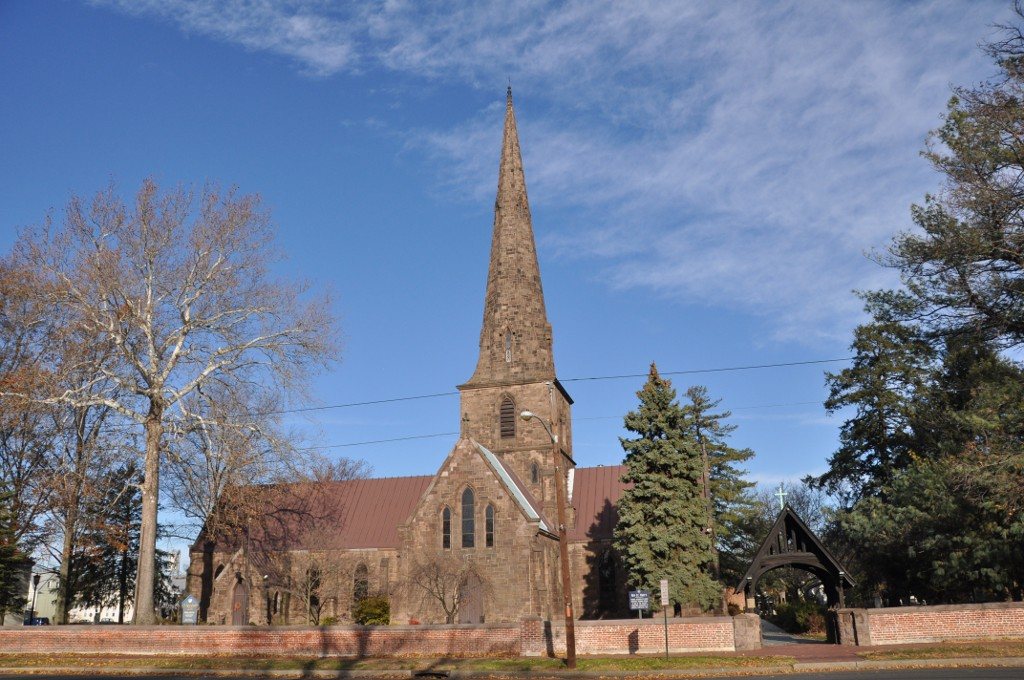
In the churchyard of St. Mary’s Episcopal in Burlington, a few blocks up from the Delaware, there is a grave most people walk past without a second look. It belongs to Elias Boudinot, who died in that town on October 24, 1821, at the age of eighty-one. If you have never heard the name, you are in good company — he is one of those founders history quietly misplaced. But on Thursday, when your family bows its head over the turkey, you will be keeping a holiday that a New Jersey congressman set in motion. That congressman is buried in Burlington County.
September 1789
Let me take you back to the first autumn under the new Constitution. It is September 1789. The ink is barely dry. The First Federal Congress, meeting in New York, has just finished the extraordinary work of proposing the amendments we would come to call the Bill of Rights. The young republic is exhausted and quarrelsome, still raw from the fight over ratification between Federalists and their opponents. And on September 25, a representative from New Jersey rises to suggest that the moment calls for gratitude.
Boudinot said he “could not think of letting the session pass over without offering an opportunity to all the citizens of the United States of joining, with one voice, in returning to Almighty God their sincere thanks.” He proposed that Congress ask President Washington to recommend a national day of public thanksgiving and prayer — a day to acknowledge the favor of Providence, and in his own careful words, the chance the people had been given to “peaceably” establish a constitution for their safety and happiness.
That word, peaceably, was not an accident. Boudinot was a lawyer by training — he had read law in Princeton as a young man under Richard Stockton — and he chose language the way a lawyer does, to say something without starting a war over it. The nation had just argued itself hoarse over the Constitution. He wanted a day that honored the fact that the argument had been settled with ballots and debate rather than muskets.
Not everyone was charmed
Not everyone was charmed. This is the part of the story I like best, because it reminds us the founders were human beings and not marble busts. Two South Carolinians objected on the spot. Aedanus Burke grumbled that he disliked this “mimicking of European customs, where they made a mere mockery of thanksgivings.” Thomas Tudor Tucker went further and raised an argument we still have today: a day of thanksgiving, he said, was “a religious matter, and, as such, is proscribed to us.” If one must be held, Tucker insisted, “let it be done by the authority of the several States.” The question of where religion belonged in public life was being argued on the floor of Congress in the same week the First Amendment was taking shape. Roger Sherman of Connecticut rose to back Boudinot, pointing to precedents in Scripture and to the days of thanksgiving Americans had long observed, and the measure carried.
Washington agreed. On October 3, 1789, in a proclamation written out by his secretary William Jackson, the President recommended and assigned “Thursday the 26th day of November next” as a day of public thanksgiving. It was the first such day proclaimed under the Constitution, and it began with a motion from a man who would spend his last years in Burlington.
It was the first such day proclaimed under the Constitution, and it began with a motion from a man who would spend his last years in Burlington.Henry Whitaker
A founder history misplaced
Boudinot was no minor figure, whatever history’s forgetfulness suggests. Years earlier he had served as President of the Continental Congress, and in that office, in April of 1783, his was the signature on the proclamation declaring an end to hostilities with Britain, and days later he signed as Congress ratified the preliminary articles of peace. When Congress was driven out of Philadelphia that same year, it was Boudinot who moved the government to Princeton, to Nassau Hall, so for a few months the capital of the United States sat in New Jersey. Later he would run the United States Mint and help found the American Bible Society. In 1805 he moved to Burlington for good, and the town has not entirely forgotten him — for years Burlington City’s Elias Boudinot Elementary School carried his name to children who mostly did not know whose it was, until the district closed it in 2018.
There is one more Burlington story worth telling, because it says something about the man. A young Cherokee named Gallegina Uwatie, traveling north to a school in Connecticut, stopped to meet Boudinot in Burlington along the way. The boy admired his host so much that he took the older man’s name as his own, and went into history as Elias Boudinot, the Cherokee editor and statesman. One name, carried by two very different Americans, both of them shaped in part by a house in Burlington County.
So this Thursday, as you pass the plate, you might spare a thought for the quiet man up the hill from the river. He did not invent gratitude, and he did not fight over who it belonged to. He simply stood up, in a divided and weary new country, and suggested that everyone take a single day to be thankful together. Two hundred and thirty-seven years later, in a South Jersey that is every bit as divided and weary, that still strikes me as about the wisest thing a representative from New Jersey ever did.
Based on reporting from Wikipedia (citing the Annals of Congress), HistoryNet, and Public Square Magazine.