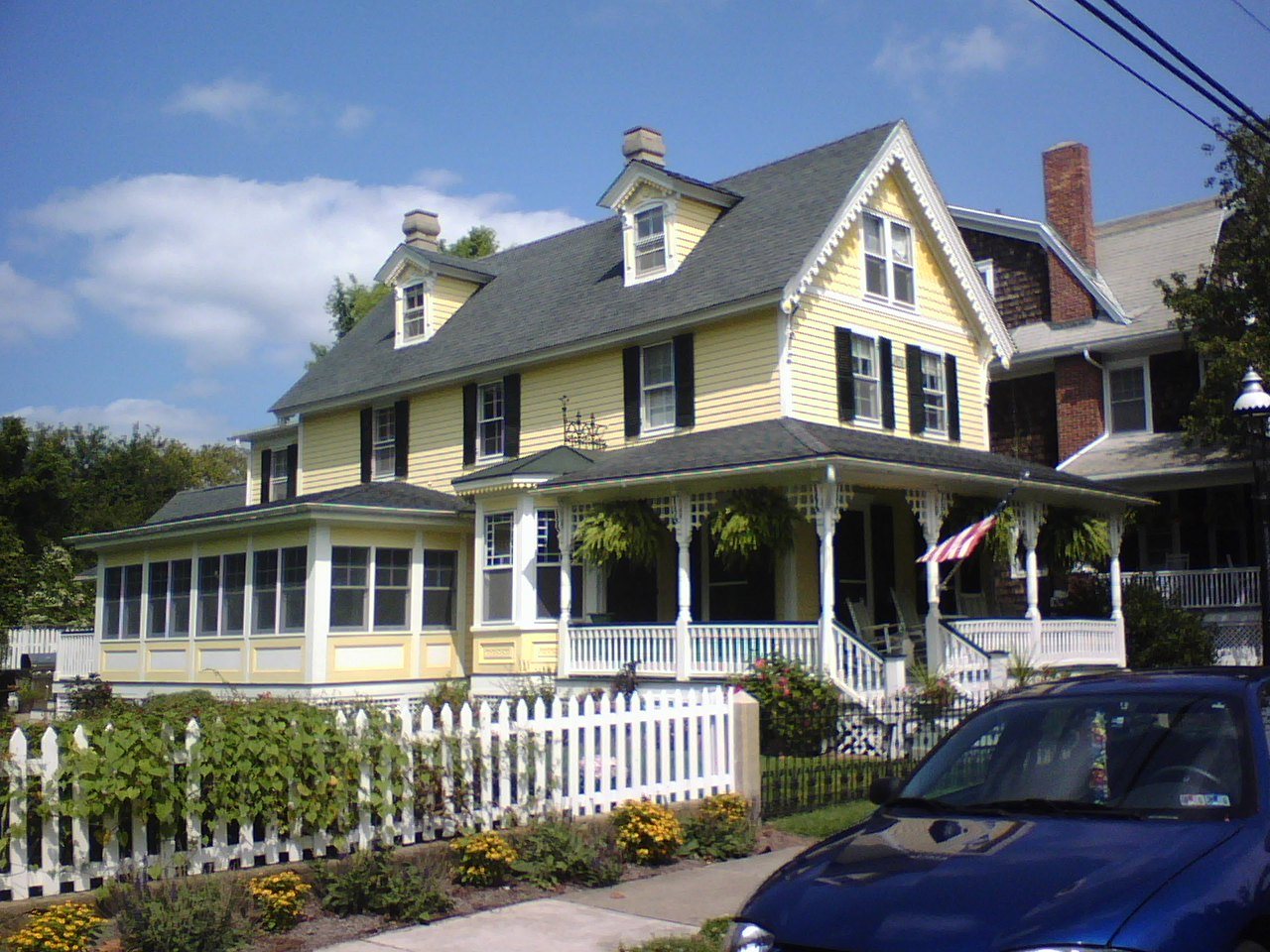
This weekend, as it does every autumn, Cape May dressed itself up in its own past. Victorian Weekend wraps up today — house tours and trolley rides, a vintage baseball game played under old rules, visitors drifting along streets of gingerbread-trimmed porches as though they’d wandered into a sepia photograph. It is a lovely performance. What most of the people taking it in don’t realize is how close the whole stage came to being torn down.
To understand Cape May, you have to start before the postcards. This was America’s first seaside resort — a destination when the country was still deciding what a vacation was. Its reachability by water from Philadelphia made it the place to flee the summer heat, and the names in its early guest registers read like a history survey: Henry Clay came, Ulysses Grant came, and Abraham Lincoln is said to have visited in 1849, more than a decade before the weight of the presidency found him. For the better part of a century, Cape May was the grandest seaside address in the young republic.
1878
Then, in 1878, it nearly ceased to exist.
The fire that November tore through the heart of town and took roughly half of it, including Congress Hall, the great hotel that had anchored the resort’s reputation. A lesser place might have faded into a footnote right there, the way so many nineteenth-century boomtowns did when their luck and their lumber ran out. Cape May did the opposite. It rebuilt, and it rebuilt fast, in the architectural language of its moment.
That timing is the whole secret. Because the town went up again in a single burst during the high Victorian era, it ended up with something almost no other American town possesses: a dense, unbroken concentration of Victorian architecture, block after block of it. Gothic Revival beside Italianate beside Second Empire beside the turrets and wraparound porches of Queen Anne. The decorative woodwork folks call “gingerbread,” the stained glass, the bay windows and steep gabled roofs, the high-ceilinged parlors and ornate staircases inside — all of it raised in the same few years, all of it still standing in rough proximity to how it looked when the paint was new. Some of the survivors predate even the fire; the George Allen House, the Italianate beauty known today as the Southern Mansion, went up in 1863.
Here is where the story turns, and where it should matter to anyone in South Jersey who has ever taken the Parkway south on a October Saturday.
The second threat
Those grand single-family homes were never built to be easy. By the middle of the twentieth century, they had become burdens — too large, too expensive, too demanding for the families who’d inherited them. Many were carved into hotels and boardinghouses. Others simply decayed. And by the postwar decades, the prevailing wisdom in American planning was not preservation but demolition. There was a serious push to clear the old Victorians away, to modernize, to let the wrecking ball do what the fire of 1878 had not finished.
What saved them was recognition — the formal, bureaucratic, deeply unglamorous act of writing down that a thing has value. Cape May’s historic core went onto the National Register of Historic Places in 1970, and in 1976, the nation’s bicentennial year, it was designated a National Historic Landmark District. Today that district covers some 380 acres and more than 600 buildings. The label is what stood between the gingerbread and the bulldozer. Without it, this weekend’s trolley tour would have rolled past parking lots and condominiums.
The label is what stood between the gingerbread and the bulldozer.Henry Whitaker
A decision, not a sentiment
I think about that every time I walk those streets. We tend to treat preservation as sentiment, a fondness for old things. It is really something closer to a decision — a town, and then a country, choosing to keep what it had instead of trading it for whatever came next. Cape May made that choice at the last possible moment, twice: once in the ashes of 1878, and again in the quieter crisis of the 1960s and ’70s, when the threat wasn’t fire but indifference.
The visitors who filled the porches this weekend came for the beauty. What they were really standing inside was the proof that a place can refuse to disappear. South Jersey is full of towns that made the other choice. Cape May is the one that didn’t — and that is the history worth remembering long after the costumes come off.
Based on historical reporting from the Cape May Historic District record and regional archives, with event details from PhillyVoice.
More South Jersey History
Henry Whitaker writes about the places and people that made South Jersey.
Read More Local News →