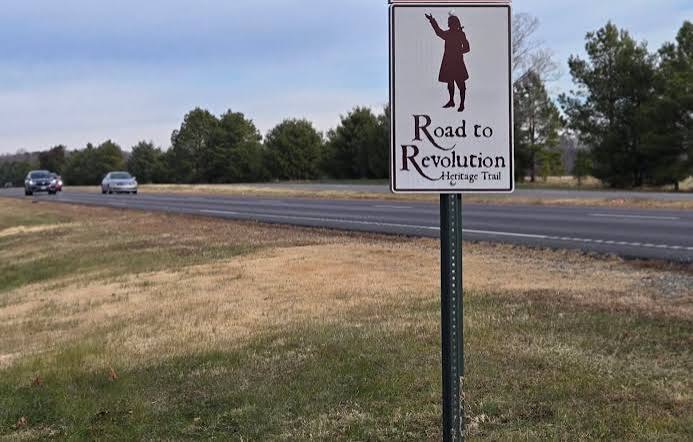
We tend to file the American Revolution under “Philadelphia” and “Boston,” as though the great events of 1776 politely stopped at the Delaware. They did not. They came across the river, into the marshes and mill towns and river crossings of what we now call South Jersey, and they left their fingerprints on ground most of us drive past every day without a second thought.
This year, in the 250th summer since the Declaration, the Camden County Historical Society has done something quietly wonderful about that forgetting. They’ve installed the American Revolution Heritage Trail — thirty-four markers scattered across the county, each one planted at a spot where the war for independence actually touched this place. Not a museum you visit once. A trail you can live inside, marker by marker, on your own schedule, at your own pace.
The ordinary becomes layered
I’ve spent a good part of the summer chasing them down, and I’ll tell you, there is a particular feeling that comes over a person standing at a roadside marker on a street they’ve known their whole life, reading that something consequential happened right there, two and a half centuries before their morning commute. It rearranges your sense of a place. The strip of road becomes a stage. The ordinary becomes layered. That is what good local history does — it doesn’t take you somewhere else, it makes where you already are suddenly deeper.
The markers connect to a larger reckoning happening across the region this year. Down at the Benjamin Cooper Tavern — the old house on the Camden waterfront where the British crossed over into the Garden State — crews have converted the building into the American Revolution Museum of Southern New Jersey. The Battleship New Jersey has hosted festivals and fireworks for the semiquincentennial. And the trail ties it all together, thirty-four points of contact insisting that the story of 1776 is not something that belongs to other towns.
That’s how a region keeps its memory alive: not with one grand monument, but with thirty-four small insistences that what happened here mattered, and still does.Henry Whitaker
The unglamorous labor of remembering
What moves me about the whole effort is that it treats history as a civic inheritance rather than a tourist product. Somebody had to research each of those thirty-four sites. Somebody had to verify the claims, write the text, secure the placement, pour the footing. That’s the unglamorous labor of remembering, and it’s usually done by volunteers and local historians who will never get their names on a marker of their own. The Salem County Historical Society, just to our south, has been at this kind of work since 1884 — more than 140 years of keeping ten thousand objects and the stories attached to them from slipping away.
I think about the schoolchildren who will grow up passing these markers. Some of them will barely register them. But a few — there are always a few — will stop, and read, and feel the past reach up through the pavement and take hold.
If you do one historical thing this August, don’t wait for the museum’s ribbon-cutting. Pick a marker near you. Drive to it. Stand there a minute. Let the road you’ve always known become, for a moment, the road it once was. The Revolution didn’t happen somewhere else. It happened here, and now there’s a trail to prove it.
Based on reporting from CBS Philadelphia, the Camden County Historical Society, and Stockton University’s South Jersey Culture & History Center.
More South Jersey Heritage
The people, places and stories that made this region. The Gazette keeps South Jersey’s history close.
Read More From the Gazette →