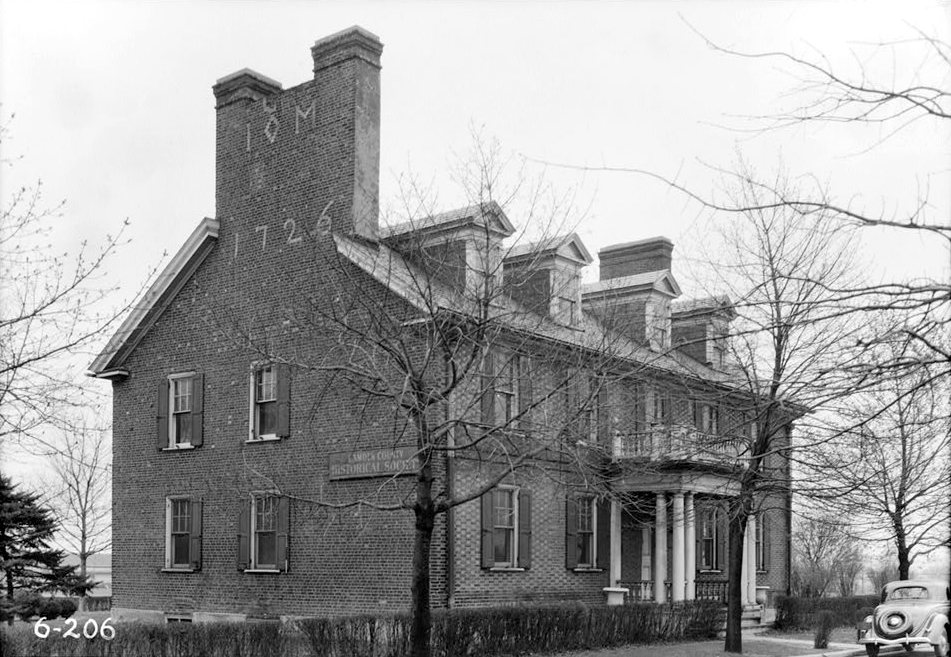
There is an old brick house in Camden called Pomona Hall, built in two stages across the eighteenth century by the Cooper family, and for most of its long life the story it told was the one the Coopers would have wanted told: a prosperous Quaker farming dynasty, a fine Georgian home, the roots of a city that still carries the family name on its bridges and its streets. It is a true story. It is simply not the whole one.
This month, if you walk through its rooms, you will hear the rest. The Camden County Historical Society, which has kept Pomona Hall for generations, now tells the history of the men and women the Coopers enslaved there — people whose labor built the comfort the house was designed to display, and whose names were for two centuries kept in the margins of the ledger when they were written down at all. More than fifty events are taking place across the county this October, and I would argue this house is the stop that matters most, because it demonstrates what the whole month is quietly trying to do.
A month of open doors
October is Camden County History Month, an annual undertaking of the Camden County History Alliance in which more than twenty historic sites and historical organizations throw open their doors — most of them free of charge — for exhibits, reenactments, and guided tours. It is easy, if you are not careful, to let a thing like this slide past as a pleasant civic ritual, the sort of calendar item that belongs between the fall festival and the leaf pickup. That would be a mistake. What is happening in these old buildings this month is the slow, serious work of a region deciding to tell its past more honestly than it used to.
Consider the range of it. In Gloucester City, you can book a History Sail aboard the schooner North Wind and hear the story of the American Revolution as it actually unfolded along the Delaware — not the tidy version taught in a textbook, but the contested, waterborne, sometimes brutal struggle for a river that both armies understood was the key to Philadelphia. In Haddonfield, the Preserving Black Haddonfield History Project is leading a walking tour of Black Haddonfield on October 10, through a neighborhood that last fall received a New Jersey Black Heritage Trail marker where none stood before, and on October 25 it hosts a Fall Harvest Gospel Concert on the lawn of the public library. A marker is a small thing, a slab of metal on a post. It is also a public declaration that something happened here, and that it is worth remembering. For a long time, a great deal that happened in this county got no marker at all.
I grew up in Salem, a town that will tell you without being asked that it is three hundred and fifty years old, founded by the Quaker John Fenwick in 1675, older than the nation it helped to make. I came up believing that South Jersey’s history was a settled matter, carved and catalogued and finished. The older I get, and the more of these doors I walk through, the more I understand that history is never finished. It is only told, and then told again, by people brave enough to add the parts their grandparents left out.
It is only told, and then told again, by people brave enough to add the parts their grandparents left out.Henry Whitaker
The 250th as a test
The timing is not incidental. The nation is in the middle of its Semiquincentennial — the 250th anniversary of the Declaration of Independence — and South Jersey, which sat squarely in the path of the Revolution, has every right to its share of that commemoration. In Camden, the 1734 Benjamin Cooper Tavern now houses the new American Revolution Museum of Southern New Jersey, a reminder that the war for independence was not fought exclusively in Boston parlors and Philadelphia halls but in the fields and crossroads and riverbanks of places like Haddonfield, Gloucester, and Red Bank. The men who marched here were not abstractions. They were farmers’ sons from the same soil that grows our tomatoes.
But a 250th anniversary is a test as much as a celebration. A county can use a milestone like this to flatter itself, to stage the parade and bunting and call it history. Or it can use the occasion the way Camden County is using this October — to put Pomona Hall’s enslaved laborers and Haddonfield’s Black families and the Delaware’s wartime dead into the same story as the Coopers and the Fenwicks and the Founders, because they were always in the same story. They simply weren’t allowed to appear in it.
That is the quiet triumph of Camden County History Month, and the reason I will spend several Saturdays this October standing in rooms I have stood in before, listening for the parts I didn’t hear the first time. The full schedule of events, with hours and locations, is posted at camdencountyhistoryalliance.com, and the majority cost nothing but an afternoon and a willingness to be surprised by a place you thought you already knew.
History, done right, is not a monument. It is a conversation, carried on across centuries, in which each generation is obliged to speak the truths the last one couldn’t. This month, a county full of old doors is holding up its end of it. The least we can do is walk through.
Based on reporting from the Camden County Historical Society, the Camden County History Alliance, the South Jersey Sun, revolutionarynj.org and the Philadelphia Inquirer.
More History & Heritage
Henry Whitaker writes about the past that still shapes South Jersey.
Read More Local News →