ATLANTIC CITY — Tomorrow is Veterans Day, and most of us will mark it the way we always do — a ceremony, a flag, a moment of quiet before the day pulls us back into itself. But a few blocks off the boardwalk, in O’Donnell Memorial Park along Albany Avenue near Ventnor Avenue, a stone temple has been keeping that quiet for more than a century, and it is worth the drive to go stand in front of it.
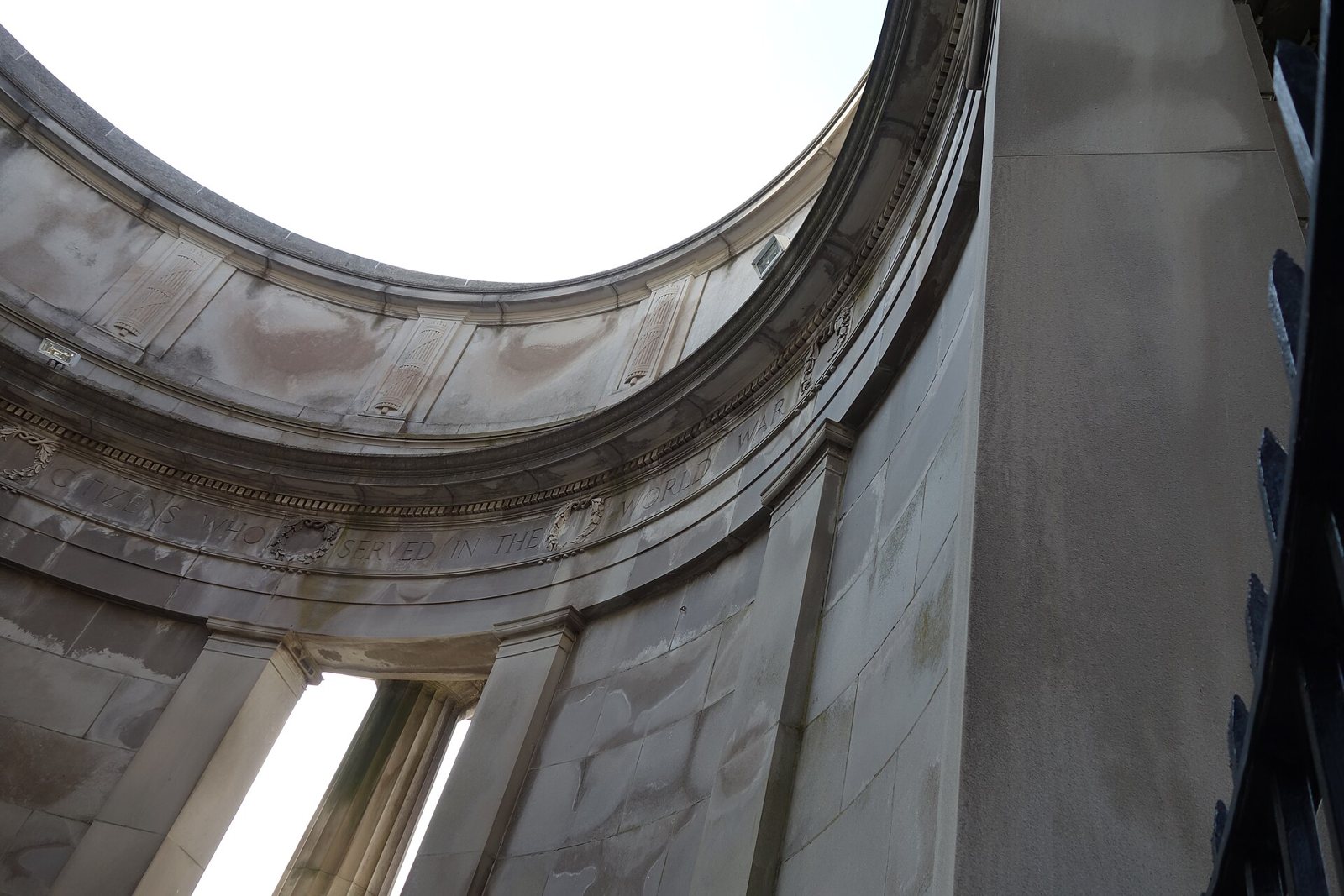
It is called, plainly, the World War I Memorial, though its form is anything but plain. Built in 1922, it is a Greek temple in miniature set down at the corner of a city park — a ring of white columns open to the salt air, holding a rotunda at its center. Walk up to it and the first thing you feel is how deliberately it reaches backward across three thousand years, borrowing the architecture of the ancient world to say something about boys from the Jersey shore who had just come home from France, or hadn’t come home at all.
A Liberty that looks shaken
Inside the rotunda stands the heart of the thing: a nine-foot bronze figure titled “Liberty in Distress,” cast by the sculptor Frederick W. MacMonnies. MacMonnies was one of the great American sculptors of his era, a man whose work you’ll find from Brooklyn to Paris, and here he gave Atlantic City a Liberty not triumphant but troubled — a figure of distress, which is a remarkable choice for a war memorial. We are used to our monuments showing victory: the soldier with his chin up, the eagle with its wings spread. This one chose to show the cost. A generation of Americans had just learned that the modern world could kill on a scale no one had imagined, and the city put up a statue honest enough to look shaken by it.
The detail rewards the patient visitor. High on the outer ring, medallions repeat in turn — Army, Navy, Marines, and Aviation, the last of these a reminder of how new flight still was, how recently men had first carried the war into the sky. And around the top, carved into the stone, run the names of the battles in which Atlantic City’s own soldiers fought. I would urge you to read them the way you’d read names on a church wall, slowly, because that is what they are. Each one is a place a local boy stood. Some of those places sent him home. Some of them kept him.
Each one is a place a local boy stood.Henry Whitaker
Boys from the shore
There is a thing that happens when you connect a monument to a map. These were not abstractions. The men honored here walked the same boards we walk, ate dinner in rowhouses that may still be standing, learned to swim in the same ocean. Then the draft notices came, and the troop ships, and they crossed an ocean they’d only ever looked at from the beach to fight in fields they’d never heard of. The temple in the park is the city’s way of holding all of that in one place — the ordinary shore childhood and the extraordinary thing history asked of it.
The nation eventually caught up to what Atlantic City understood early. In the summer of 1981, the memorial was recognized on both the New Jersey Register of Historic Places and, that August, the National Register of Historic Places — official acknowledgment that this little temple is not merely decoration but a document, a primary source in stone and bronze. But registers and reference numbers are the bureaucracy of memory. The memory itself lives in the standing still of it, in the way the columns frame the gray November sky, in the figure of Liberty who has been keeping her troubled vigil through every storm and every summer crowd since Warren Harding was president.
We tend to think of our shore towns as places of amusement, and they are, gloriously so. But every one of them also sent its young people to the wars of the last century, and the shore remembers in its own understated way — a plaque here, a name on a firehouse there, and in Atlantic City, this temple by the sea. Armistice Day, the holiday’s original name, marked the hour the guns of the First World War finally fell silent: the eleventh hour of the eleventh day of the eleventh month, 1918. That silence is what this monument was built to hold.
Go stand inside it
So tomorrow, if you find yourself near the boardwalk, take the short walk inland. Stand inside the ring of columns. Read a battle name or two off the stone. The stone is cold and the salt air is never far off, and both of those things are exactly as they should be. A century on, Liberty is still in distress, still standing, still ours to look after. The least we can do is come look.
Based on the Historical Marker Database, Clio, WHYY, Wikipedia and the National Register of Historic Places.
More South Jersey History
Henry Whitaker finds the history hiding in plain sight around South Jersey.
Read More Local News →